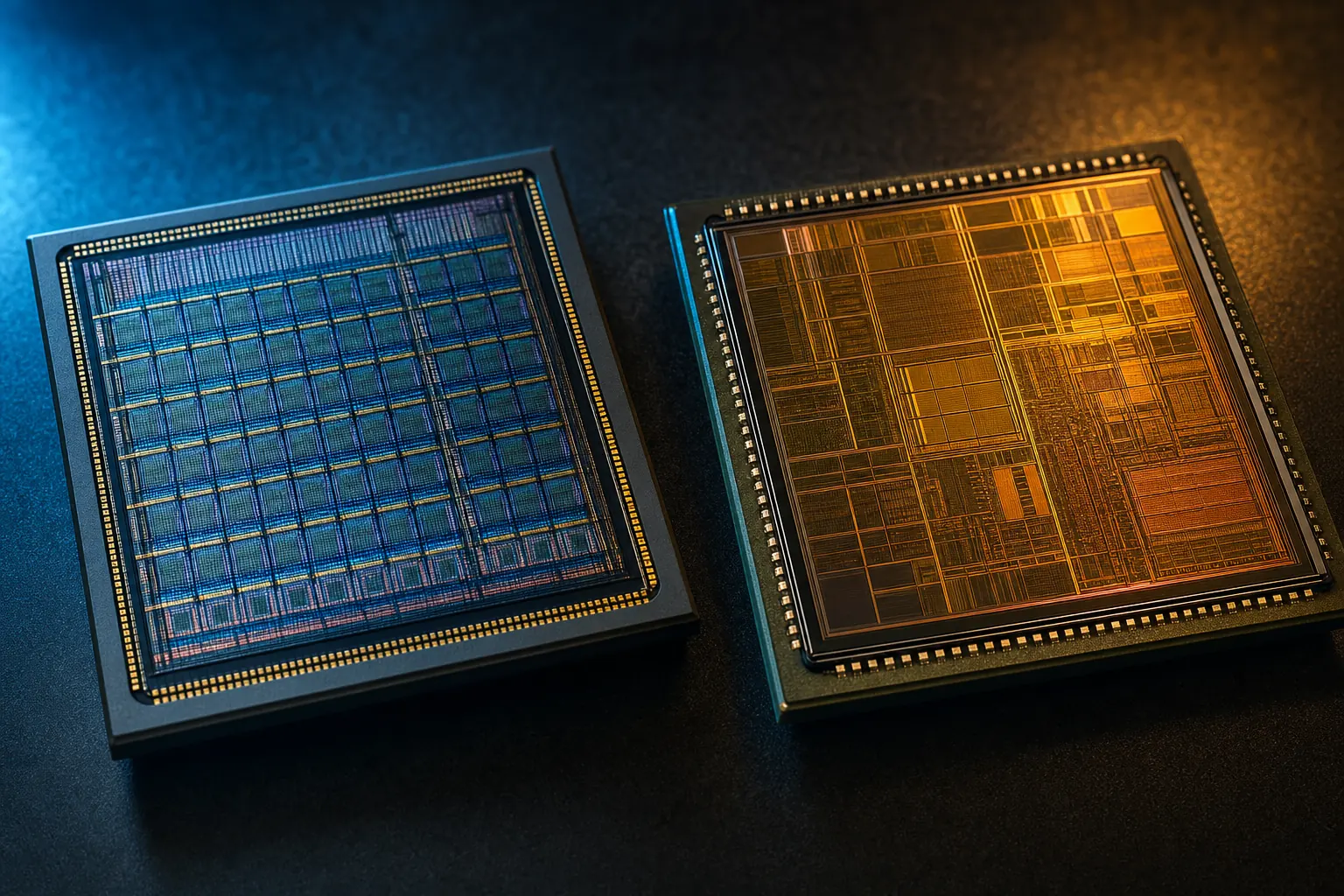
Industry update — On 27 May 2026, AMD announced new Versal Prime Series Gen 2 adaptive SoCs in packages as small as 23×23 mm, delivering up to ~100k DMIPs of scalar compute — a fresh data point in the perennial FPGA-versus-ASIC decision, where reconfigurable silicon keeps closing the efficiency gap without an ASIC’s mask cost or time-to-market (AMD, 27 May 2026).
FPGA vs ASIC is one of the foundational decisions in digital hardware, and it is settled far more by economics and schedule than by raw silicon performance. An ASIC can be smaller, faster and cheaper per unit — at enormous up-front cost and risk. An FPGA is reprogrammable, fast to bring up and low-risk — at a higher per-unit price. This guide lays out the honest FPGA vs ASIC trade-offs across non-recurring engineering (NRE) cost, volume, time-to-market and flexibility, then explains why IP reuse is the lever that makes the FPGA path both quick and dependable.
FPGA vs ASIC: the short answer
Choose an FPGA for low-to-moderate volumes, fast time-to-market, and designs that may change — you avoid the huge up-front cost and risk of custom silicon, and you keep the ability to reprogram. Choose an ASIC only at high volume, where the per-unit savings and performance eventually repay a very large, irreversible non-recurring engineering (NRE) investment. The FPGA route’s biggest accelerator is reusing proven IP cores instead of building complex logic from scratch.
FPGA vs ASIC: what is the difference?
An FPGA (Field-Programmable Gate Array) is a chip whose logic you configure after manufacture — and reconfigure as often as you like. The same physical part can be a storage controller today and something else tomorrow. An ASIC (Application-Specific Integrated Circuit) is custom silicon designed and fabricated for one purpose; once made, its function is fixed forever. That single difference — reprogrammable versus fixed — drives every FPGA vs ASIC trade-off that follows. If you are new to the building blocks that go inside the fabric, our primer on what an FPGA IP core is (soft IP vs hard IP) is a useful companion to this comparison.
What are the core trade-offs?
The FPGA vs ASIC decision balances up-front cost against per-unit cost, and flexibility against ultimate performance. An ASIC carries a large non-recurring engineering (NRE) cost and a long, high-stakes development cycle, but rewards it with the lowest per-unit cost and the best performance and power at scale. An FPGA flips that: minimal up-front commitment, fast bring-up, and the freedom to change — at a higher cost per device. Because the exact numbers are program-specific, this comparison stays deliberately qualitative; treat any single-figure “FPGA vs ASIC cost” claim online with caution.
FPGA vs ASIC: side-by-side comparison
| Factor | FPGA | ASIC |
|---|---|---|
| Up-front cost (NRE) | Low | Very high |
| Per-unit cost | Higher | Low at volume |
| Time to market | Fast | Long |
| Flexibility | Reprogrammable | Fixed at fabrication |
| Performance / power | Good | Best at scale |
| Development risk | Low (re-spin in tools) | High (re-spin = new mask) |
| Best volume | Low to moderate | High |
At what volume does an ASIC win?
The economics hinge on volume. At low and moderate volumes, the FPGA’s lack of up-front cost dominates — you would never amortize an ASIC’s NRE over a few thousand units. At very high volumes, the ASIC’s low per-unit cost eventually overtakes, and the large up-front investment pays back. The crossover point is program-specific — it depends on your NRE, per-unit delta and lifetime quantity — but the principle is constant: low volume favors FPGA, high volume can justify ASIC.
Many aerospace, defense and instrumentation programs sit firmly in FPGA territory — moderate volume, high mix, change expected. That is exactly where reusable IP shines.
How an FPGA reduces risk
Beyond cost, the FPGA’s reprogrammability is a risk-management tool. A bug found late is a tool re-run, not a new silicon mask costing a fortune and months. Requirements that evolve mid-program are a configuration update, not a redesign. For systems with long lifecycles or shifting specifications — common in aerospace and defense, where an FPGA-based avionics data bus may outlive several requirement revisions — that flexibility is often worth more than any per-unit saving.
Why does IP reuse matter?
Here is the lever that decides whether the FPGA path is fast or slow: what you put into the fabric. If you write every complex interface from scratch — the NVMe storage controller, the SATA storage interface, the networking MAC — you spend your schedule re-implementing and re-verifying solved problems. If instead you reuse proven IP cores for those interfaces, you collapse months of work into integration and spend your effort on what is actually unique to your product. The same reuse discipline is what lets one design serve both a data bus and a high-speed data-acquisition path on a single FPGA.
This is the same logic behind the make-vs-buy decision covered in our FPGA IP vendor buyer’s checklist: an ASIC team reuses verified IP blocks as a matter of course, and an FPGA team should too. When building in-house is not the right call, an IP-focused FPGA design house supplies and integrates those cores. IP reuse is what turns the FPGA’s fast-bring-up promise into a real, dependable schedule.
SoC FPGAs: the middle path
The FPGA vs ASIC question is not always binary. Modern SoC FPGAs combine hardened processor cores with programmable logic on one device, and structured-ASIC options sit between full-custom silicon and an FPGA. These middle paths let you keep programmable flexibility for the parts of a design that change while hardening the parts that are stable — another reason moderate-volume, high-mix programs so often land on the FPGA side of the line rather than committing to custom silicon.
When the choice is not really yours
Sometimes external factors decide the FPGA vs ASIC question for you:
- Extreme volume or power targets. A consumer product at massive scale, or a power budget only custom silicon can meet, points to ASIC regardless of preference.
- Qualified-part requirements. A program may mandate a specific qualified FPGA family, fixing the path and the device.
- Time pressure. A schedule that cannot absorb an ASIC’s development cycle effectively mandates an FPGA, IP reuse included.
Frequently asked questions
When should I use an FPGA instead of an ASIC?
Use an FPGA for low-to-moderate volumes, fast time-to-market, and designs that may change. You avoid the huge up-front cost and risk of custom silicon and keep the ability to reprogram, at the price of a higher per-unit cost.
When does an ASIC make sense?
At high volume, where the low per-unit cost and superior performance and power eventually repay a very large, irreversible non-recurring engineering (NRE) investment and a long development cycle. Below that volume, the FPGA is almost always the better economics.
Is an FPGA cheaper than an ASIC?
It depends on volume. An FPGA is far cheaper up front because it has almost no NRE, so it wins at low and moderate volumes. An ASIC is cheaper per unit and can win total cost only once volume is high enough to amortize its large up-front investment.
Why is IP reuse so important on the FPGA path?
Because writing complex interfaces from scratch spends your schedule re-solving solved problems. Reusing proven IP cores for storage, data-bus and networking interfaces collapses months of work into integration, letting you focus on what is unique to your product.
Is an FPGA slower than an ASIC?
An ASIC can achieve higher performance and lower power at scale because it is custom silicon. An FPGA’s performance is very capable for most systems, and its reprogrammability and low risk often outweigh the gap outside high-volume products.
What makes an FPGA lower risk than an ASIC?
An FPGA bug is fixed by re-running the tools, not by paying for a new silicon mask. Evolving requirements are a configuration update rather than a redesign, which matters for long-lifecycle aerospace and defense systems.
Where do aerospace and defense programs usually land?
Frequently in FPGA territory: moderate volume, high mix and evolving requirements, where reprogrammability and IP reuse deliver schedule and risk advantages over custom silicon.
On the FPGA path and want to skip building storage or data-bus logic from scratch? Reusing a proven core is the fastest way there.