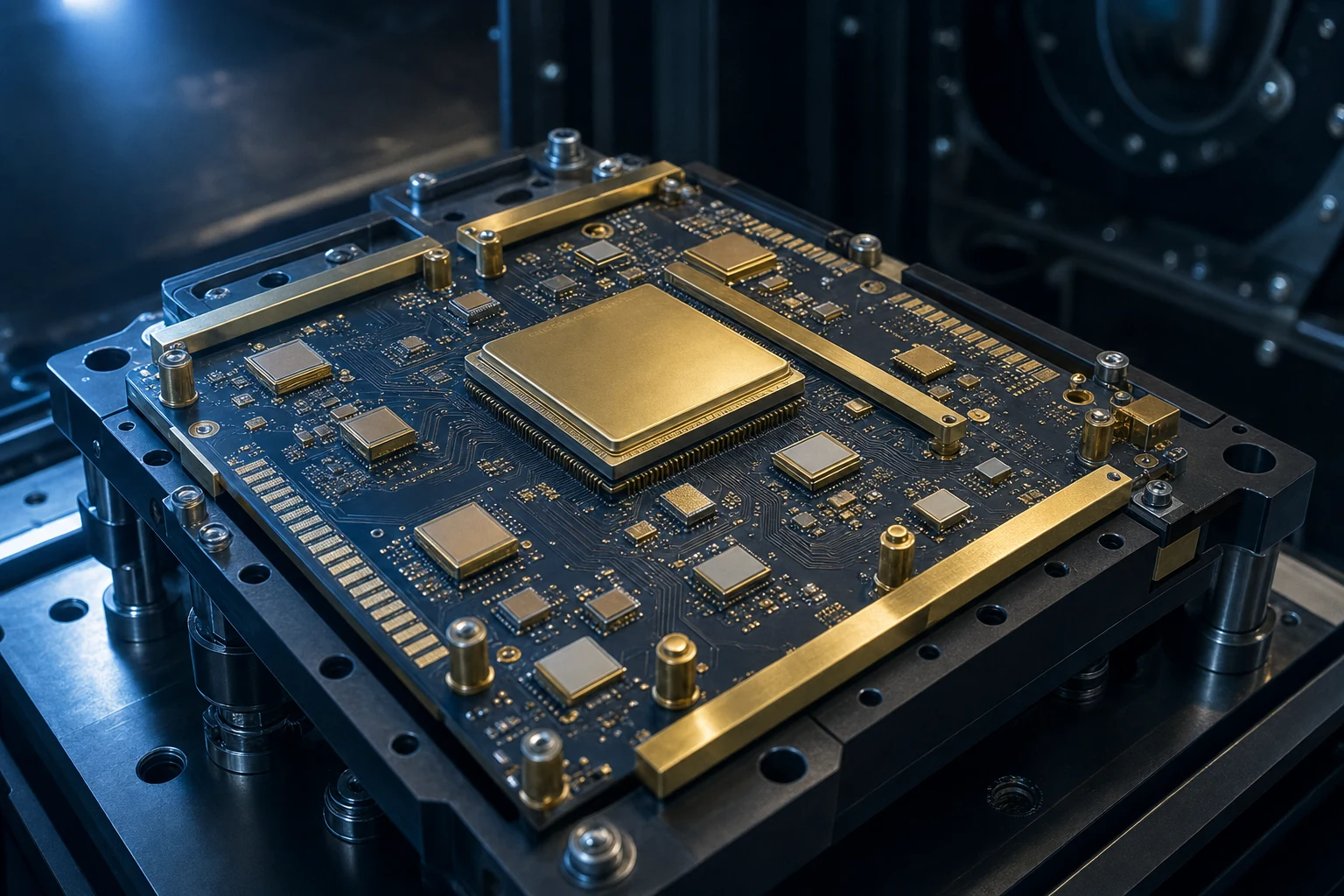
Industry update — NASA flew Artemis II, the first crewed lunar flyby in more than 50 years, from 1 April to 10 April 2026 — 9 days, 1 hour and 32 minutes with the crew and their avionics outside the shelter of low Earth orbit (NASA, Artemis II mission page). Two months later GlobalFoundries’ deputy director for space and rad-hard drew the engineering conclusion in public: “missions like Artemis II demonstrate that success today depends on something far more immediate: silicon that can endure the harsh realities of space” (GlobalFoundries, 1 June 2026).
In short: “rad-hard”, “rad-tolerant” and “COTS” describe how much radiation behaviour a vendor has characterised and guaranteed — not a single ranking. Radiation attacks an FPGA through several distinct mechanisms — dose, upsets, transients, functional interrupts and latch-up — each with its own countermeasure. For a soft-IP core, three questions matter: does it re-target to the rad-tolerant part, how much upset surface does it add, and does it ship as source you can harden yourself?
Every space or strategic-defence programme reaches the same fork: the payload processing you want is easy on a commercial FPGA, and the part you are allowed to fly is not that FPGA. The device list narrows, the fabric shrinks, and every block has to answer for its behaviour under particles. This guide sets out what the grades mean, what the effects do to a programmable device, which mitigation answers which — and then the part usually skipped: what all of it changes for the soft-IP cores you were planning to license.
- The short answer
- Radiation-hardened, radiation-tolerant, COTS: what the labels mean
- What radiation actually does to an FPGA
- Mitigation: TMR, scrubbing and EDAC
- The space-grade FPGA families you will be asked to target
- What it means for soft IP
- Where this guide stops applying
- Frequently asked questions
The short answer
Pick the grade from the mission, not the marketing. Rad-hard devices are hardened by design or by process and carry guaranteed total-dose and latch-up limits; rad-tolerant devices are commercial architectures with characterised, specified radiation performance; COTS parts carry no radiation guarantee at all. Then treat the effects separately: TMR answers upsets in logic, scrubbing answers upsets in configuration memory, EDAC answers upsets in data memory, and device selection answers dose and latch-up. For the IP you license, three criteria decide: re-targetability to the rad-tolerant family, how little state the core carries, and whether it arrives as HDL source you may modify.
Radiation-hardened, radiation-tolerant, COTS: what the labels mean
The labels are often read as a quality ladder. They are closer to three different contracts between you and the silicon vendor.
- COTS — a commercial part with no radiation specification. It may well survive a short low-Earth-orbit mission behind aluminium, and much smallsat hardware is built this way, but characterisation, lot screening and failure consequences are entirely yours. There is no number to design against, only your own test campaign.
- Radiation-tolerant (RT) — a commercial architecture whose radiation behaviour has been measured, specified and put on a datasheet. AMD publishes for its RT Kintex UltraScale device a typical total ionizing dose of 100 krad(Si) in geostationary orbit, a maximum of 120 krad(Si), and latch-up immunity to 80 MeV-cm²/mg — numbers you can put in a radiation budget.
- Radiation-hardened (RH) — hardened from the ground up, by design (RHBD) or by process (RHBP), typically qualified to the highest microcircuit classes. AMD’s RH Virtex-5QV is specified at a minimum of 1 Mrad(Si) with latch-up immunity of at least 100 MeV-cm²/mg — an order of magnitude more dose than the RT part, in exchange for far less fabric on a much older node.
The trap is reading those labels as a single scale. NanoXplore describes NG-ULTRA as a radiation-hardened-by-design SoC FPGA with upset immunity validated above 60 MeV-cm²/mg — and a total dose tolerance of 50 krad(Si), below the rad-tolerant AMD part quoted above. Neither vendor is being loose: dose and single-event effects are independent axes. Read the two numbers separately, against your own orbit, shielding and mission duration.
What radiation actually does to an FPGA
Total dose is a slow drift you budget for at end of life; single-event effects are stochastic — one particle, a random moment, a random cell. What makes FPGAs special is that an SRAM-based device holds its circuit in memory: an upset in configuration RAM does not corrupt data, it rewires logic.
| Effect | Impact on the design | Usual mitigation |
|---|---|---|
| TID — total ionizing dose | Cumulative charge trapping shifts thresholds and raises leakage. Parameters drift, timing margin erodes, the part fails at end of life. | Device selection against a mission dose budget with margin; shielding; worst-case timing at end-of-life corners. A selection problem, not a runtime one. |
| SEU — single-event upset in configuration memory | On an SRAM-based FPGA a flipped configuration bit changes routing or a LUT value. The logic itself is now wrong, and stays wrong until the frame is rewritten. | Continuous configuration scrubbing — read back, detect, rewrite — usually via a vendor soft-error-mitigation controller. Or remove the mechanism: flash-configured devices hold no configuration in SRAM. |
| SEU — upset in user state | A flipped flip-flop, block RAM word or FIFO pointer. Counters jump, state machines enter illegal states, a buffered packet becomes corrupt. | TMR on registers and state machines; EDAC/ECC on block RAM and external memory; interleaving against multi-bit upsets; safe-state FSM encoding with an explicit illegal-state branch. |
| SET — single-event transient | A voltage glitch in combinational logic or on a clock or reset net. Harmless unless a flip-flop captures it — then it becomes an upset. | Temporal redundancy (sample the same value at spaced instants and vote), filtering on asynchronous control nets, care with reset and clock distribution. |
| SEFI — functional interrupt | A whole block stops behaving — configuration controller, PLL, transceiver, hard IP. The device does not produce a wrong bit, it stops producing. | Watchdog with a defined recovery path: reset the block, reload configuration, power-cycle. Vendors publish a SEFI rate per device per day to size that budget. |
| SEL — single-event latch-up | A parasitic thyristor turns on, current runs away, the device can be destroyed. The one failure here that no software recovers from. | Choose a device whose latch-up immunity exceeds your worst-case linear energy transfer, backed by current-limited, fast-trip power sequencing at board level. |
Two of those rows drive most architectural decisions. Configuration upsets are why SRAM FPGAs need a scrubber running for the whole mission — AMD quotes a configuration-RAM SEFI rate of 4.5×10⁻⁴ per device per day in GEO for RT Kintex UltraScale, and 1.3×10⁻⁵ for the XQR Versal. Latch-up immunity is why device selection, not clever RTL, is the first line of defence.
Mitigation: TMR, scrubbing and EDAC
The three classical mitigations are not alternatives. Each answers a different row above, and a flight design normally runs all three at once.
Triple modular redundancy
Triple modular redundancy (TMR) triplicates a function and votes on the three outputs, so a single corrupted copy is outvoted. It costs roughly three times the resources plus voters, extra routing pressure, and — the part people forget — a resynchronisation strategy so a corrupted copy holding state rejoins the other two instead of diverging permanently. Applied selectively to state machines and control paths it is affordable; applied blindly to a whole datapath it is what pushes a design off the device.
Configuration scrubbing
Scrubbing continuously reads back configuration memory, detects an upset through frame-level codes and CRCs, and rewrites the affected frame before a second upset accumulates. On AMD devices that is the Soft Error Mitigation controller, delivered as a LogiCORE IP block. Note what scrubbing does not do: it repairs the circuit definition, not the user state computed while the circuit was wrong. TMR and EDAC still sit above it.
Error detection and correction
EDAC covers stored data: block RAM, FIFOs, external DDR, anything in flight over a link. Single-error-correct/double-error-detect codes handle the common case, and interleaving spreads adjacent cells across different code words so one particle upsetting two neighbouring bits does not defeat the code. NanoXplore states that NG-ULTRA embeds EDAC to protect user memory; on other families you add it yourself, in the memory controller or the IP that owns the buffer.
The space-grade FPGA families you will be asked to target
The shortlist is short, and each vendor sits at a different point on the fabric/dose/heritage triangle.
- Microchip RT PolarFire and RT PolarFire SoC. The distinguishing property is non-volatile configuration: holding no configuration in SRAM, these devices are — Microchip states — immune to configuration-memory upsets, which removes external mitigation of that effect and takes the scrubber out of the system. Microchip announced MIL-STD-883 Class B and QML Class Q qualification of the RTPF500ZT and engineering samples of the RT PolarFire SoC, a Linux-capable RISC-V subsystem alongside the fabric with a roadmap to QML Class V and Class Y, and claims up to 50% lower power than mid-range SRAM-based alternatives.
- AMD RT Kintex UltraScale and XQR Versal. The high-throughput end. The RT Kintex UltraScale device (20 nm) uses, in AMD’s words, “more than 40 proprietary, patented circuit design and layout techniques to reduce the SEU cross-section”. The XQR Versal adaptive SoCs add vector and AI engines for on-board processing, with Class B qualification announced for the VC1902 then the VE2302. Both quote 100 krad(Si) typical dose in GEO and 80 MeV-cm²/mg latch-up immunity, and separate on configuration-RAM upset rate. Behind them, the heritage line of the RH Virtex-5QV and RT Virtex-4QV, at 1 Mrad(Si) and 300 krad(Si).
- NanoXplore NG-ULTRA. The European option, with the sovereignty argument attached. NanoXplore presents it as the first radiation-hardened-by-design SoC FPGA: STMicroelectronics 28 nm FD-SOI, 500K four-input LUTs, a quad-core Arm Cortex-R52 subsystem, SEU immunity validated above 60 MeV-cm²/mg, 50 krad(Si) total dose, embedded EDAC on user memory.
Two consequences follow: fabric is scarce once a design is triplicated, and the hard blocks — PCIe controller, transceivers, memory interfaces, processor subsystem — are not the same across these three vendors, which is exactly where a portable IP core stops being portable.
Targeting a rad-tolerant part and wondering whether a storage or avionics interface core will re-target cleanly? That is a short technical conversation, not a procurement exercise.
What it means for soft IP
This is where a radiation article usually stops and the integrator’s work begins. Three questions decide whether a licensed core belongs in a space design.
1. Does the core re-target to the rad-tolerant family?
RTL is nominally portable; the wrapper never is. A storage or network core binds to a PCIe hard block, transceiver primitives, a memory controller and a register-bus convention that differ across vendors, so the honest question is not “is it portable?” but “has it already been ported, and to what?”. Our own catalogue shows the pattern: the NVMe Host IP exists for AMD families over AXI, for Altera Agilex 7 R-Tile over Avalon, and for Microchip PolarFire and PolarFire SoC, where the recorder variants use an APB register interface. A core that has crossed three interconnect conventions and three vendors has had its family dependencies isolated once — that is the property you are buying, not a promise about a device it has never seen.
2. How much upset surface does the core add?
A protocol implemented in fabric and the same protocol implemented in software have very different radiation profiles. A hardware NVMe, SATA or ARINC 429 host keeps state machines, queues and framing inside the FPGA: no processor in the data path, no operating system, no driver stack, no software image in external DRAM to scrub or reload. The upset surface reduces to fabric flip-flops and block RAM — precisely what TMR and ECC handle well and cheaply. And that surface is enumerable: an ARINC 429 line running at up to 2.5 Mbit/s, a SATA III link at 6 Gbps, an NVMe host addressing 512 B or 4096 B sectors with an I/O queue buffer configured anywhere from 32 KB to 1024 KB. Those are the published parameters of our own cores, and each one is a bounded quantity of state you can count, triplicate and cover with ECC — unlike a software stack, whose upset surface is whatever the linker produced. It is the argument that makes a CPU-less avionics data recorder attractive on a certification-bound programme, applied to a different hazard.
3. Does it arrive as source you may modify?
Hardening is invasive: you will want to triplicate selected state machines, change FSM encoding, add ECC to a buffer, or re-run synthesis with different constraints for the RT device. None of that is possible against an encrypted netlist. We deliver our cores in VHDL or Verilog source with C-source drivers, and list DO-254 documentation as available on request across most of the catalogue — an input to your design-assurance effort, not a substitute for it.
The boundary has to be said plainly: our cores are offered as portable to RT-grade parts, and we publish no space qualification for them. Qualification is program-level — it attaches to a device, a board, an assembly flow and a design-assurance argument that you own, never to an RTL deliverable on its own.
Where this guide stops applying
A design framework, not a radiation analysis. Four places where you must stop reading and start specifying:
- Your mission environment is not in this article. Dose, particle flux and worst-case linear energy transfer depend on orbit, solar cycle, shielding and duration. Derive them from your own environment specification against the applicable standards — ECSS in Europe, NASA’s parts and packaging guidance.
- The figures quoted here are vendor reference numbers. GEO typicals from public datasheets and product pages, useful for comparing families. They are not your mission’s rates, and no substitute for the datasheet of the exact part number your radiation budget must cite.
- Immunity to configuration upsets is not immunity. A flash-configured device removes one important mechanism. Flip-flops, block RAM, transceivers and hard blocks still upset; SEFI and latch-up still apply. TMR and EDAC do not become optional.
- Resource cost is design-specific. What TMR, scrubbing and ECC cost in LUTs, flip-flops, block RAM and timing margin depends on your design and device. Size it from your own implementation results, never a generic multiplier.
In summary
The grades describe how much radiation behaviour a vendor has characterised and guaranteed, and dose and single-event performance are independent axes to read separately against your own mission. Each effect has its own answer — device selection for dose and latch-up, scrubbing for configuration memory, TMR for logic, EDAC for stored data — and they run together. At the IP layer the questions are narrower than the physics suggests: has the core already been ported to the family you must fly, how little state does it carry, and does it arrive as source you are permitted to harden?
Frequently asked questions
What is the difference between radiation-hardened and radiation-tolerant FPGAs?
Radiation-hardened devices are engineered for the environment from the ground up, by design or by process, and carry guaranteed total-dose and latch-up limits with the highest qualification classes. Radiation-tolerant devices start from a commercial architecture and add process, layout and screening measures so that radiation behaviour can be characterised and specified on a datasheet. The practical consequence is that rad-hard parts usually offer far more total dose margin, and rad-tolerant parts usually offer far more fabric on a newer process. Neither label is a single ranking: compare the total ionizing dose figure and the single-event numbers separately, against your own orbit and mission duration.
Do flash-based FPGAs still need TMR?
Yes. A flash-configured device such as RT PolarFire holds its configuration in non-volatile cells, which Microchip states makes it immune to configuration-memory upsets and removes the need for external mitigation of that effect — so no configuration scrubber is required. But user state is not configuration: flip-flops, block RAM, FIFOs and hard blocks can still be upset by a particle, and single-event functional interrupts and latch-up remain in scope. TMR on control logic and ECC on memories stay part of the design.
Is triple modular redundancy always necessary?
No, and applying it everywhere is a common way to run out of device. TMR is expensive — roughly three times the resources plus voters, extra routing pressure and a resynchronisation strategy for redundant copies that hold state. The usual approach is selective: triplicate state machines, control registers and anything whose corruption is unrecoverable, protect bulk data with error-correcting codes instead, and let short-lived datapath values be covered by the fact that they are overwritten every cycle. What deserves TMR follows from your failure analysis, not from a blanket rule.
Can I reuse the same IP core on a commercial FPGA and on a rad-tolerant one?
The RTL usually transfers; the family-specific wrapper does not. Storage and interface cores bind to a PCIe hard block, transceiver primitives, a memory controller and a register-bus convention, and those differ between AMD, Altera and Microchip devices. The question to ask a vendor is therefore not whether a core is portable in principle but which families it has already been delivered on, and over which bus. A core that already exists in AXI, Avalon and APB variants has had its family dependencies isolated once, which is what makes the next port predictable.
Does putting a soft CPU inside the FPGA increase radiation risk?
It increases upset surface. A processor brings register files, caches, a software image in memory and an execution state that can be corrupted in ways that are hard to detect and harder to recover deterministically. That is manageable — many space designs fly processors, with ECC on memories, watchdogs and defined restart paths — but it is a larger hardening problem than a fabric-only state machine. Where a function can be implemented as hardware, for instance a storage or avionics bus host that keeps its protocol entirely in fabric, the radiation argument favours doing so.
Are Logic Design Solutions IP cores space-qualified?
No, and we do not claim it. Our cores are portable to RT-grade parts — the NVMe Host IP already exists for Microchip PolarFire and PolarFire SoC, for AMD families over AXI and for Altera Agilex 7 over Avalon — and we deliver in VHDL or Verilog source with C-source drivers, with DO-254 documentation available on request across most of the catalogue. Qualification itself is program-level: it applies to a specific device, board, assembly flow and design-assurance argument, and it is established by your programme, not by an IP deliverable.
How we write these guides: they are drafted by the engineers who build and support our cores. Radiation figures are quoted from the device vendors’ own public pages and datasheets and attributed to them; our own product capabilities are limited to what we publish on our product pages; and resource utilisation, latency and measured throughput are deferred to the target core’s datasheet and your own implementation results.
Tell us the device you have to fly, the interfaces you need and the fabric you have left after triplication — we will tell you which core fits, and what the port involves.
- NASA — Artemis II mission page: the crewed lunar flyby of 1–10 April 2026 and its 9-day mission profile.
- GlobalFoundries — From Artemis II to deep space (1 June 2026): radiation-hardened-by-design and by-process manufacturing, and the quoted conclusion on space-grade silicon.
- AMD — Space solutions: published radiation tables for the RT Kintex UltraScale, XQR Versal, RH Virtex-5QV and RT Virtex-4QV devices, and the Class B qualification announcements.
- AMD — Soft Error Mitigation Controller LogiCORE IP Product Guide (PG036): how configuration-memory scrubbing is implemented on AMD devices.
- SatNews — Microchip expands its space-qualified FPGA portfolio (10 July 2025): RTPF500ZT qualification, RT PolarFire SoC engineering samples, and the non-volatile configuration claim.
- NanoXplore — NG-ULTRA: RHBD SoC FPGA specifications, SEU immunity, total dose tolerance and embedded EDAC.
- Single-event upset and triple modular redundancy: general definitions of the effect and the voting scheme.
- NASA — Electronic Parts and Packaging (NEPP) Program: radiation effects guidance and parts assurance for flight electronics.
- ECSS — European Cooperation for Space Standardization: the standards set against which European space environment and parts requirements are specified.