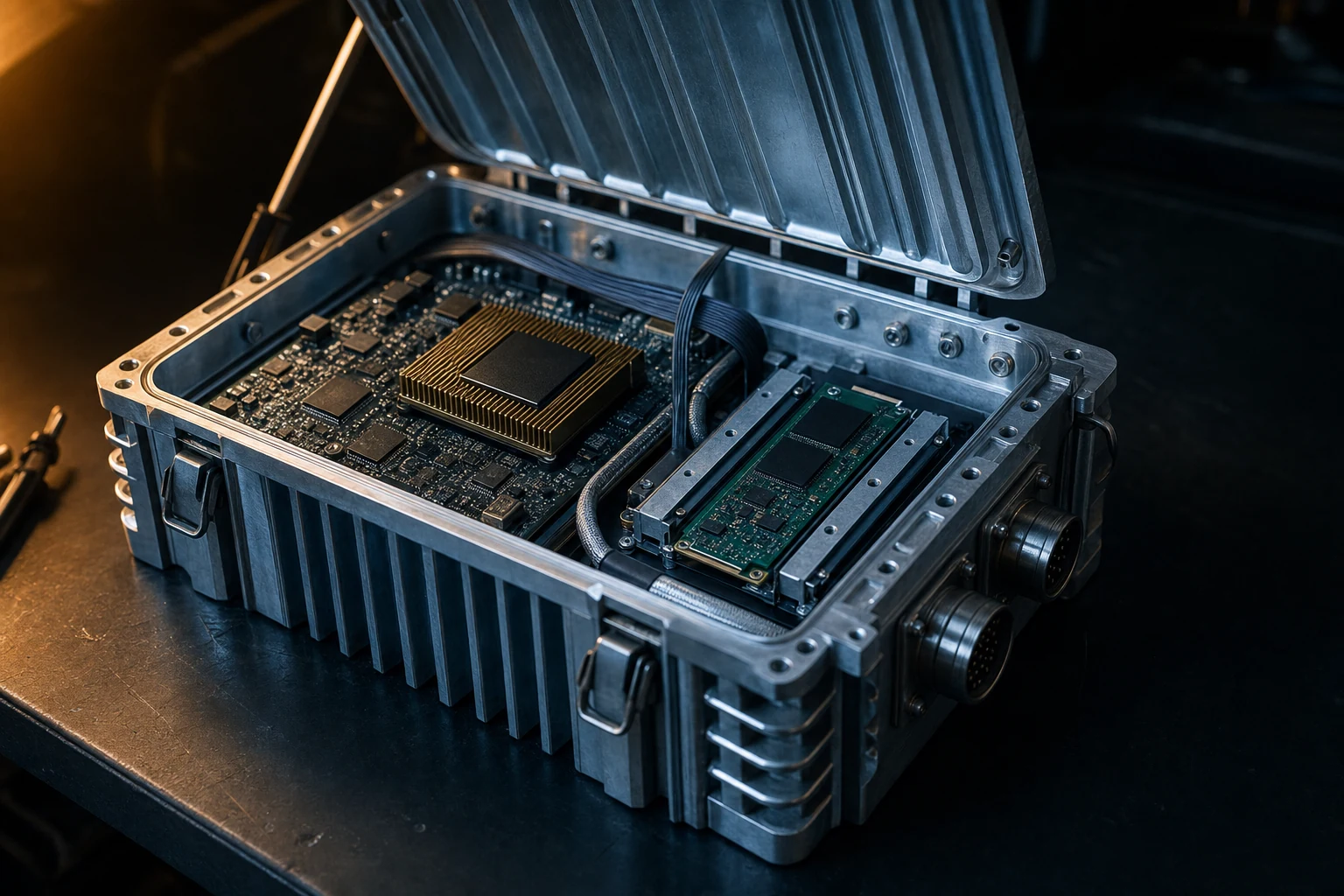
Industry update — On 30 July 2026 the US National Transportation Safety Board published its final report into the fatal Bering Air Flight 445 accident (Cessna 208B, 6 February 2025) and “reiterated previous recommendations calling for … expanded use of flight data monitoring programs … and crash-resistant flight recorder systems for certain aircraft” — a reminder that recording capability is increasingly something system designers are expected to build in rather than bolt on (NTSB, 30 July 2026).
In short: an avionics data recorder can live entirely in FPGA fabric — ARINC 429 IP decodes the buses, fabric logic timestamps each word, FIFOs absorb the bursts, and a recorder IP writes the stream to an SSD. No CPU, no operating system, no scheduler in the data path.
Mission systems, flight-test installations and supplemental acquisition units all ask the same question: how do we capture everything moving on the aircraft’s ARINC 429 buses, stamp it with a trustworthy time and put it on media that survives the bay — without dragging an operating system into a certification-bound programme? Most architects converge on a single FPGA: decode, timestamping, buffering and the storage host controller all in fabric, with a commercial SSD as the only consumable. That is the shape of a modern avionics FPGA recorder. Here is the reference architecture block by block, plus the three things absent from the block diagram: determinism, environmental qualification, and what soft-IP licensing really buys on a DO-254 programme.
- The short answer
- What the recorder has to do
- The reference architecture, block by block
- The bandwidth arithmetic that changes the design
- Determinism: taking the CPU out of the data path
- Environmental and rugged constraints
- Soft IP on a certification-bound programme
- Where this pattern stops applying
- Frequently asked questions
The short answer
Put the whole recorder in fabric. An ARINC 429 IP core terminates the receive lines — the RX and TX line counts are build-time parameters, set by generics at instantiation — decodes the return-to-zero bit stream, checks parity and filters on labels, then pushes each 32-bit word into a per-channel FIFO. Your own logic attaches a timestamp and formats a fixed-size record. A recorder IP, NVMe over PCIe or SATA, drains that stream to an SSD, optionally through a FAT32 or exFAT File-System IP so the media reads back on a laptop. Control registers sit on AXI-Lite, Avalon or APB depending on the family; the payload never touches them. No processor, no operating system in the capture path — which is the point.
What the recorder has to do
“Data recorder” covers two very different boxes. A crash-protected recorder — the orange box built to EUROCAE’s ED-112A specification — is a regulated, approved article with an armoured memory unit. Most programmes are building the other one: a mission-system or flight-test recorder that captures far more parameters at higher fidelity for debrief, maintenance or flight-data monitoring, and is not required to survive an impact. Its requirements are short and unforgiving:
- Capture every word. A recorder that silently drops samples is worse than none: it yields a plausible file with holes in it.
- Timestamp at the source. The value of 429 traffic lies in ordering and intervals across buses. A stamp applied after a queue, a driver and a scheduler has already lost that.
- Run unattended from power-on. No login, no mount, no boot sequence to fail.
- Produce readable media, and survive the bay. Someone has to get the data off; temperature, vibration and EMI are design inputs.
Every one of those argues against a general-purpose computer and in favour of fabric.
The reference architecture, block by block
What follows is a reference design pattern, not a product: how these systems are typically decomposed, and which block is a licensable core, which is yours to write, and which is simply a component on the board. Being explicit about that split is what makes a build plan honest.
| Architecture block | Role | Where it comes from |
|---|---|---|
| ARINC 429 line interface | Converts the bus’s bipolar RZ levels to logic levels. | Board components — outside the FPGA, not an IP core. |
| ARINC 429 protocol engine (RX) | Decodes the RZ bit stream per line, recovers 32-bit words, checks parity (odd, even or none), filters on labels. | LDS ARINC 429 IP — RX/TX line counts set by generics; independent Rx/Tx, FIFOs and interrupts. |
| Timestamp and record formatter | Stamps each word from a free-running counter; packs word, time and channel ID into a fixed-size record. | Your fabric logic — application-specific. |
| Elastic buffer stage | Absorbs burst arrivals and rate-matches capture to storage. | Per-channel FIFOs in the ARINC 429 IP, plus fabric FIFOs you size for the aggregate. |
| Storage host controller | Implements the drive protocol in hardware: link bring-up, queues, commands. | LDS NVMe Host IP (PCIe Gen2 to Gen5, AMD / Altera / Microchip families) or LDS SATA Host IP. |
| Recorder data path | Turns the host controller into a continuous logger, with no CPU issuing each transfer. | NVMe Host Recorder IP or SATA III Recorder IP (RAID0 across disks). |
| File system on the media | Optional: writes a mountable volume instead of raw blocks. | LDS FAT32 or exFAT File-System IP, delivered in C source. |
| Control plane | Label filters, start/stop, drive identify, error counters. | AXI-Lite (AMD), Avalon (Altera), APB (PolarFire recorders) — registers only, never payload. |
| Storage media | Non-volatile capture medium. | Commercial NVMe or SATA SSD. |
Read left to right, that is the system: 429 IP → FIFO and format → recorder IP → SSD. Two licensed cores and one block of application logic between the aircraft bus and the flash.
Scoping a recorder like this? Line count, target FPGA family and storage interface are the three decisions that shape everything else.
The bandwidth arithmetic that changes the design
Engineers new to this class of system start by worrying about storage throughput. The arithmetic says to worry about something else.
ARINC 429 is a deliberately modest bus. It carries 32-bit words — label, SDI, data, SSM, parity, as broken down in our guide to the ARINC 429 word format — at 12.5 kbit/s low speed or 100 kbit/s high speed, with a minimum four-bit-time gap between words. A high-speed line running flat out therefore yields on the order of 2,800 words per second. Pack each into a 12-byte record (32-bit payload, 64-bit timestamp) and one saturated channel produces roughly 34 kBytes/s. Even several dozen saturated high-speed lines — which real installations are not — land in the low single-digit MBytes/s. Against that, the only sustained figure Logic Design Solutions publishes for its recorder line is on the order of 500 MBytes/s over one 6 Gbit/s SATA link, and the NVMe recorders sit on PCIe generations well beyond it.
The margin is two to three orders of magnitude, and the consequence matters more than the number: throughput stops being the design driver and integrity takes over. What consumes real effort is timestamp resolution and stability, guaranteeing no word is lost during a flush or a drive housekeeping event, and ensuring a power interruption leaves a readable file. Teams that size this like a video recorder optimise the wrong axis for months.
Determinism: taking the CPU out of the data path
The same recorder built around a processor running Linux or an RTOS looks simpler on a slide and behaves worse on the bench. Every software stage adds variable delay: interrupt latency that depends on what else is pending, a scheduler that may not run your thread this tick, a driver queue, a page cache that flushes when it decides to. That variance is not fatal for throughput — buffers absorb it — but it is fatal for timestamp fidelity. If the time value is applied when software reaches the sample rather than when the word arrived on the wire, the recorded interval between two events on two buses measures your software stack, not the aircraft.
In fabric the picture inverts. The protocol engine raises a word-complete event at a fixed point in the bit stream, a counter in the same clock domain is sampled at that instant, and the record forms in a fixed number of cycles. The latency is not merely low, it is constant — which is what post-flight analysis needs. A hardware storage host extends the property downstream: the NVMe recorder path issues commands from a state machine, so write cadence does not depend on an OS being idle. A quieter benefit: no processor in the data path means no kernel, scheduler or driver stack to justify in the assurance argument for that path.
One honest caveat: Logic Design Solutions does not publish measured end-to-end latency figures, so treat this as a structural argument — fixed-cycle logic versus a scheduler — and measure your own numbers on the bench.
Environmental and rugged constraints
A recorder that works on a desk and fails at altitude has been prototyped, not designed. Three constraints shape the physical build, and the IP solves none of them.
Qualification applies to the unit, not the core
Airborne equipment is qualified against RTCA DO-160 (EUROCAE ED-14): temperature and altitude, vibration, humidity, power input, lightning-induced transients, RF emission and susceptibility. That testing is done on your board, enclosure and connectors — a soft-IP core has no physical existence. What the architecture affects is how much box there is to qualify: a single-FPGA design with an SSD has fewer parts and interfaces than one carrying a processor subsystem, its DRAM and its boot flash.
The SSD is the weak link
The FPGA and the fabric logic run across a wide temperature range. Consumer flash does not. Industrial-temperature drives, power-loss-protected parts and honest attention to write endurance across the mission profile separate a recorder from an intermittent one. This is where the media decision bites too: raw block capture is the most robust to abrupt power removal, while a mounted file system carries metadata that must stay consistent when power disappears.
Crash protection is a different programme
If the requirement genuinely is a crash-protected recorder, the memory must sit in a crash-survivable unit built and tested to ED-112A, and the article becomes a regulated, approved product. An FPGA recorder can feed or coexist with such a unit, but the armoured module is separate engineering and separate approval. Settle which box you are building before the architecture freezes.
Soft IP on a certification-bound programme
Where airworthiness obligations exist, schedule risk comes from evidence rather than logic. RTCA DO-254, the design assurance guidance for airborne electronic hardware, expects a traceable path from requirements through design to verification, and that reaches into every complex device on the board — the FPGA included. Three properties of licensed soft IP matter.
Source-code delivery. Logic Design Solutions ships its cores as VHDL or Verilog source with drivers in C source, across essentially the whole catalogue. That is a certification detail, not a commercial one: an encrypted netlist you cannot read is hard to fold into an assurance data package, whereas readable HDL can be reviewed, traced to requirements and simulated inside your own verification.
A documentation package on request. Most of the catalogue is listed with DO-254 documentation available on request, and the legacy ARINC 429 macro carries a DO-254 reference explicitly. Two cautions: an IP core is never “certified” on its own — approval attaches to the airborne system through the aircraft or equipment approval route — and the assurance level applicable to your function (DAL A to D) comes from your safety assessment, not from the core. Ask precisely what the package contains.
Protocol risk retired up front. ARINC 429 decode, NVMe queue handling and SATA link management are well-bounded problems your team would otherwise specify, implement, verify and document from scratch. Licensing them moves that off the critical path and leaves the verification budget for the part that is genuinely yours: timestamping, record format and failure behaviour.
Where this pattern stops applying
- You need a certified crash-protected recorder. ED-112A and an approved crash-survivable memory unit then define the product, and the FPGA is one subsystem inside a far larger approval effort.
- Your data is not mainly ARINC 429. MIL-STD-1553, AFDX or high-rate video need their own front ends; the storage half of this architecture still holds, the capture half does not.
- You need in-flight analysis, not just capture. Search, alerting and operator interaction are software problems. Record in fabric, then hand the media or a summary stream to a processor.
- You are counting resources or closing timing. LUT, FF, BRAM and DSP utilisation, achievable clock rates and end-to-end latency are specific to each core, each family and your constraints — take them from the datasheet and your own implementation runs, never from an article. AMD’s UltraFast Design Methodology Guide covers the clock-domain and timing work involved.
In summary
An avionics FPGA recorder is a short chain: ARINC 429 IP decodes and filters the receive lines, fabric logic timestamps and formats each word, FIFOs absorb the bursts, and an NVMe or SATA recorder IP writes the stream to an SSD. Bandwidth is comfortable by orders of magnitude, which frees the effort for what matters: constant-latency timestamping, no-drop capture and clean behaviour on power loss. Removing the CPU buys determinism on the bench and a smaller argument to defend on a DO-254 programme, while licensing the protocol cores in source form keeps schedule risk where you can manage it.
Frequently asked questions
Can an FPGA record ARINC 429 traffic with no CPU at all?
Yes, and that is the usual arrangement. The ARINC 429 IP decodes each receive line into 32-bit words and FIFOs them, fabric logic timestamps and formats them, and a recorder IP implements NVMe or SATA in hardware to write the stream to the SSD. Every stage is a state machine, so no processor, driver or operating system sits in the capture path. A small controller is still useful for power-on configuration, but it touches the control registers only.
How many ARINC 429 receive channels can one FPGA handle?
That is set when you build, not by a catalogue number: in the LDS ARINC 429 IP the TX and RX line counts are generic parameters chosen at instantiation, so the ceiling is your device’s resources and the line receivers on the board. Because a saturated high-speed 429 line generates only tens of kBytes per second, storage bandwidth is essentially never what limits channel count.
Should the recorder write raw blocks or a file system?
Raw capture is fastest and most robust to abrupt power loss, but the media then needs a tool to read it back. A FAT32 or exFAT File-System IP layer writes a volume that mounts directly on a ground-station PC, at the cost of metadata that must stay consistent through an interruption. Note the published constraints: FAT32 caps the disk at 2 TB and a single file at 2 GB; exFAT removes those limits and runs at raw-format speed but supports 512-byte LBA only.
Does using licensed IP make the recorder DO-254 certified?
No, and precision matters here. Approval attaches to the airborne system, not to a soft-IP core in isolation. What licensed IP does is support your design assurance effort: Logic Design Solutions delivers cores in VHDL or Verilog source with C-source drivers, and lists DO-254 documentation as available on request across most of the catalogue. Confirm what that package contains against your plan, and remember the applicable assurance level comes from your own safety assessment.
NVMe or SATA for an avionics recorder?
For pure ARINC 429 capture either is far more than sufficient, so choose on integration rather than throughput. SATA is the simpler board-level interface and its recorder IP stripes across several disks in RAID0; NVMe over PCIe scales much higher and suits a unit that also records video, radar or high-rate sensor data alongside the 429 buses. Availability on your chosen FPGA family often decides it.
What about vibration and temperature requirements?
Those apply to the unit, not the IP. Airborne equipment is qualified against RTCA DO-160 (EUROCAE ED-14) for temperature, altitude, vibration, power characteristics and EMI, on your board and enclosure. Where the architecture helps is part count: a single-FPGA recorder with an SSD has fewer components and interfaces to qualify than one carrying a processor subsystem, DRAM and boot flash. The SSD deserves particular attention — industrial-temperature, power-loss-protected parts.
How we write these guides: they are drafted by the engineers who build and support our cores. Product capabilities are limited to what we publish on our own product pages; the architecture above is a reference design pattern, and resource utilisation, latency and measured throughput are deferred to the target core’s datasheet and your own implementation results.
Building an ARINC 429 recorder, or weighing an NVMe against a SATA storage path? Tell us the line count, the FPGA family and the mission profile.
- NTSB — Bering Air crash final report, 30 July 2026: the reiterated recommendations on flight data monitoring and crash-resistant recorders.
- SAE ITC / AEEC — ARINC Standards: publisher of the ARINC 429 specification.
- RTCA — Standards: publisher of DO-254 (airborne electronic hardware design assurance) and DO-160 (environmental test procedures).
- EUROCAE: publisher of ED-112A for crash-protected recorder systems, and of ED-14.
- NVM Express, Inc. — NVMe Specifications: the queue and command model an NVMe recorder core implements in hardware.
- SATA-IO: the Serial ATA specifications behind the 6 Gbit/s link.
- eCFR — 14 CFR Part 135: the US operating rules referenced in those recommendations.
- AMD — UltraFast Design Methodology Guide (UG949): clock-domain crossing and timing closure guidance.