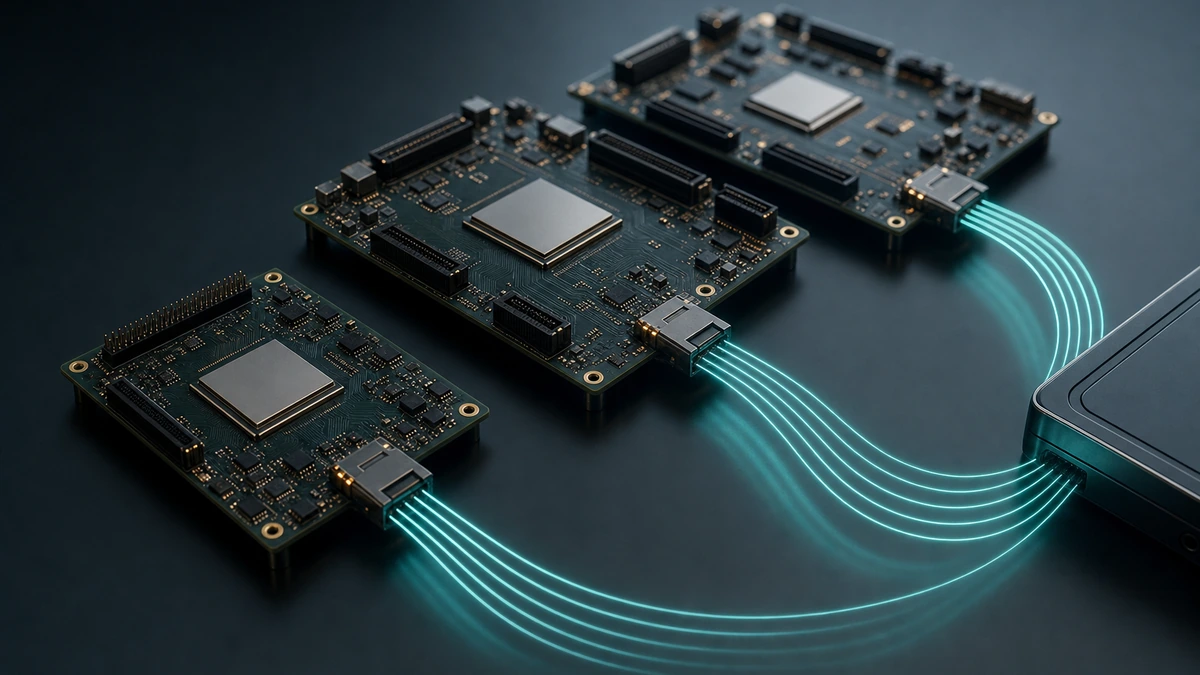
Industry update — Altera has extended product lifecycle support for its Cyclone V, MAX 10 and Agilex FPGA families through 2045, reinforcing the case for building long-life storage subsystems, including SATA host designs, on proven Altera platforms (Altera Newsroom, April 2026).
If your storage design targets an Altera FPGA, the practical question is not whether a SATA host can be built in the fabric — it can — but which family gives you the transceivers, cost and headroom the rest of the system needs. The LDS SATA Host IP core is written to sit on Altera’s serial transceivers, so the same core follows you across Cyclone, Arria and Stratix. This guide explains what that line supports, how the three families differ for a SATA host role, and what actually changes when you port between them. It reflects Logic Design Solutions’ experience delivering the SATA Host IP core across Altera and Xilinx FPGA families; as of 2026, Altera’s line spans Cyclone, Arria, Stratix and the newer Agilex generation.
The short answer
The LDS SATA Host IP core targets the transceivers built into Altera’s FPGA families, so it runs on Cyclone (low-cost, power-sensitive designs), Arria (the mid-range balance of performance and cost) and Stratix (high-end, transceiver-rich systems), with Agilex covering the latest generation. Pick the family from the whole system’s needs — transceiver availability, the SATA generation you require, logic budget and power — not from the SATA host alone, which is a comparatively small block. The core is designed to move with you as that decision changes.
The SATA Host IP line on Altera
A SATA host is the side of the link that issues commands — it talks to a drive or SSD, rather than pretending to be one. Building that host in an FPGA means implementing the SATA protocol stack (the link and transport layers, command handling and the interface to the transceiver) as soft logic in the fabric, and driving the physical serial link through the device’s own high-speed transceivers.
The LDS SATA Host IP is a soft IP core written for exactly that job on Altera silicon. Because it is portable RTL that connects to the family’s native transceivers rather than to one specific device, the same core targets the low-cost, mid-range and high-end families. That is the point of buying proven IP instead of writing a host from scratch: you keep the protocol implementation constant and let the FPGA family be a system decision, not a rewrite.
The SATA Host IP does not stand alone in the LDS catalogue. Teams building storage and data-movement systems often pair it with, or choose between, related cores — a SATA Device IP for the drive side, an NVMe Host IP for PCIe-attached SSDs, a 10G Ethernet MAC, an ARINC 429 interface for avionics buses, and an exFAT file-system IP when the recorded data has to be readable on a PC. The SATA host is frequently the on-ramp to a larger recording or acquisition design. If you are still weighing the host role against a device role in the first place, our SATA host and device IP selection guide walks through that decision.
What a SATA host needs from the FPGA
Before comparing families, it helps to know what the SATA standard demands of the device underneath. SATA is a serial interface: one differential pair per direction, running at one of three defined generations. Per the SATA specification maintained by SATA-IO, the line rates are 1.5 Gbit/s (Gen1), 3.0 Gbit/s (Gen2) and 6.0 Gbit/s (Gen3). A SATA host in an FPGA therefore needs two things from the silicon:
- A transceiver that reaches your target generation. The serial line rate has to be within the range the family’s transceivers support. This is the single hardest constraint, and it is where the families genuinely differ.
- Enough fabric for the protocol logic and your application. The host stack itself is a modest block, but it rarely lives alone — it shares the device with buffering, a file system, an application and often other interfaces.
Everything else — clocking, reset, the command interface — is common engineering. In short: the family choice is dominated by transceiver capability first, then by logic and power budget.
Cyclone, Arria and Stratix compared
In short: Cyclone is the low-cost entry, Arria the mid-range default, and Stratix the transceiver-rich high end — and the same SATA Host IP core runs on all three. Altera’s three long-running families are positioned along a cost-versus-performance axis. Cyclone is the low-cost, low-power line; Stratix is the high-end, highest-performance line with the richest transceiver resources; Arria sits deliberately in the middle. The table below compares them qualitatively for a SATA host role — it intentionally avoids per-device numbers, because transceiver counts and speeds vary by specific part and variant within each family.
| Family | Market positioning | Transceivers | Typical SATA host fit |
|---|---|---|---|
| Cyclone | Lowest cost, low power, high-volume and cost-sensitive designs | Available on transceiver-equipped variants; the entry tier of serial capability | Single or few SATA links in a small, price- or power-constrained recorder or embedded system |
| Arria | Mid-range; a balance of performance, transceiver capability and cost | More capable serial transceivers than Cyclone, without Stratix pricing | The common default for SATA host designs that need solid throughput and some headroom |
| Stratix | High-end; maximum performance, logic density and transceiver resources | The richest and fastest transceivers in the line-up | Many parallel SATA links, or a SATA host alongside other demanding high-speed interfaces |
Read the table as a ladder rather than three isolated choices. As you move from Cyclone to Arria to Stratix you buy more transceiver capability, more logic and more speed — and you pay for it in unit cost and power. The SATA host core is the same across all three; what changes is the room around it.
Not sure which Altera family your SATA host design belongs on? An engineer who has mapped the core onto all three can talk it through against your real requirements.
How do you choose between Cyclone, Arria and Stratix?
Decide the SATA generation and link count first, then add the rest of the system, then trade cost and power against headroom. The decision is easier when you take it in that order, because the constraints are not equally binding.
1. Start with the SATA generation and link count
Decide how many SATA links you need and at which generation. A single Gen1 or Gen2 link is undemanding and opens up the low-cost end of the range; several links at the highest generation push you up toward the transceiver-rich end. This is the constraint that most often rules a family in or out, so settle it first.
2. Add the rest of the system
A SATA host almost never fills a device on its own. Add the buffering, the file system, the application logic and any other interfaces sharing the chip. A design that is comfortable on a small family with the host alone may need a larger one once everything else is in.
3. Weigh cost and power against headroom
Cyclone wins on unit cost and power; Stratix wins on capability and headroom; Arria is the balance point many storage designs land on. If your volumes are high and the system is lean, the pull is toward Cyclone. If you are integrating several fast interfaces or want room to grow, it is toward Stratix. Arria is the sensible middle when neither extreme is obviously right.
Because the LDS SATA Host IP is the same core on each family, you can make this a clear-eyed system trade-off. You are choosing the device around a fixed, proven host — not re-engineering the host to fit a device.
Does the SATA Host IP run on Agilex too?
Yes. Agilex is Altera’s latest-generation family, positioned above the classic three on process technology, transceiver performance and power efficiency. For a SATA host it is rarely a requirement — SATA generations are well within older families’ reach — but it becomes relevant when the SATA link is one small part of a modern, transceiver-heavy design that is already on Agilex for other reasons. In that case, keeping the SATA host on the same device as the rest of the system, rather than adding a separate FPGA, is the natural move. The same portability argument applies: the core targets the family’s transceivers, so being on the newest generation does not mean starting over.
How do you port the core between families?
One of the reasons to standardise on a portable SATA host is that FPGA family decisions change — a cost target tightens, a link count grows, a part goes end-of-life. Porting the core is a transceiver-and-constraints exercise, not a rewrite. When you move it between Altera families, most of the work is not in the protocol logic:
- Transceiver configuration is the main task. The serial PHY is the part most tied to the family. Moving between families means re-targeting the transceiver for the new device’s primitives and regenerating its configuration for your SATA generation. The protocol stack above it stays constant.
- Clocking and constraints get revisited. Clock resources and timing constraints are device-specific, so the clocking scheme and constraint files are checked and adjusted for the target part.
- Resource and timing closure are re-verified. A larger or smaller family changes how comfortably the whole design fits and closes timing. This is verification work, not redesign — but it is real, so budget for it rather than assuming a port is free.
- The command interface stays put. The way your application talks to the host — issuing reads and writes — is designed to be stable across families, so the logic on your side of the core should not need reworking.
The same portability holds across vendors, not just across Altera families: the LDS SATA Host IP also targets AMD/Xilinx devices, and we walk through one such build in SATA Host IP on Xilinx Kintex UltraScale+. Whether you stay on Altera or cross to Xilinx, using a core built for portability from the start is precisely what keeps a family change a re-targeting job rather than a redesign.
What this article does not cover
To keep the comparison honest, a few things are deliberately out of scope here:
- Specific device numbers. Exact transceiver counts, top line rates and logic capacities differ by individual part and variant within each family — always confirm them against the current Altera documentation for the part you are considering.
- Guaranteed throughput on a given family. Real-world storage throughput depends on the drive, the file system, buffering and the application, not on the SATA host alone. Treat any single figure with suspicion.
- SATA versus NVMe. Whether SATA is even the right interface — against an NVMe/PCIe path — is a separate decision with its own trade-offs.
Need a SATA host or device IP core for a specific FPGA family? Talk to the team that builds them.
Frequently asked questions
Which Altera families does the LDS SATA Host IP support?
The core targets Altera’s serial transceivers, so it runs across the Cyclone (low-cost), Arria (mid-range) and Stratix (high-end) families, and on the latest-generation Agilex. Because it connects to the family’s native transceivers rather than a single device, the same core follows the design as the family choice changes.
Can a low-cost Cyclone FPGA run a SATA host?
Yes, on transceiver-equipped Cyclone variants. Cyclone is the entry tier of serial capability, which suits a single or small number of SATA links in a cost- or power-constrained system. Confirm that the specific Cyclone part has transceivers reaching your target SATA generation.
When should I choose Arria over Cyclone or Stratix?
Arria is the mid-range balance point. Choose it when you need more transceiver capability and headroom than Cyclone offers but do not need Stratix’s maximum resources or pricing. Many SATA host storage designs land on Arria for exactly that reason.
What SATA generations exist, and do the families reach them?
SATA defines three generations: 1.5 Gbit/s (Gen1), 3.0 Gbit/s (Gen2) and 6.0 Gbit/s (Gen3), per the SATA-IO specification. Whether a given family and part reaches a generation depends on its transceivers, which is the first thing to confirm from the device documentation.
How hard is it to port the SATA host between Altera families?
The bulk of the work is re-targeting the transceiver and revisiting clocking and constraints for the new device, then re-verifying resource fit and timing. The protocol stack and your command interface stay constant, so it is a re-targeting and verification exercise rather than a rewrite.
Does the SATA host use most of the FPGA?
No. The SATA host protocol logic is a comparatively small block. It typically shares the device with buffering, a file system, the application and often other interfaces, which is why the family should be chosen from the whole system’s needs rather than the host alone. Exact utilisation depends on your configuration and target part.
Building a SATA host on Cyclone, Arria or Stratix and want to skip writing the protocol stack from scratch? A proven, portable core is the fastest route.