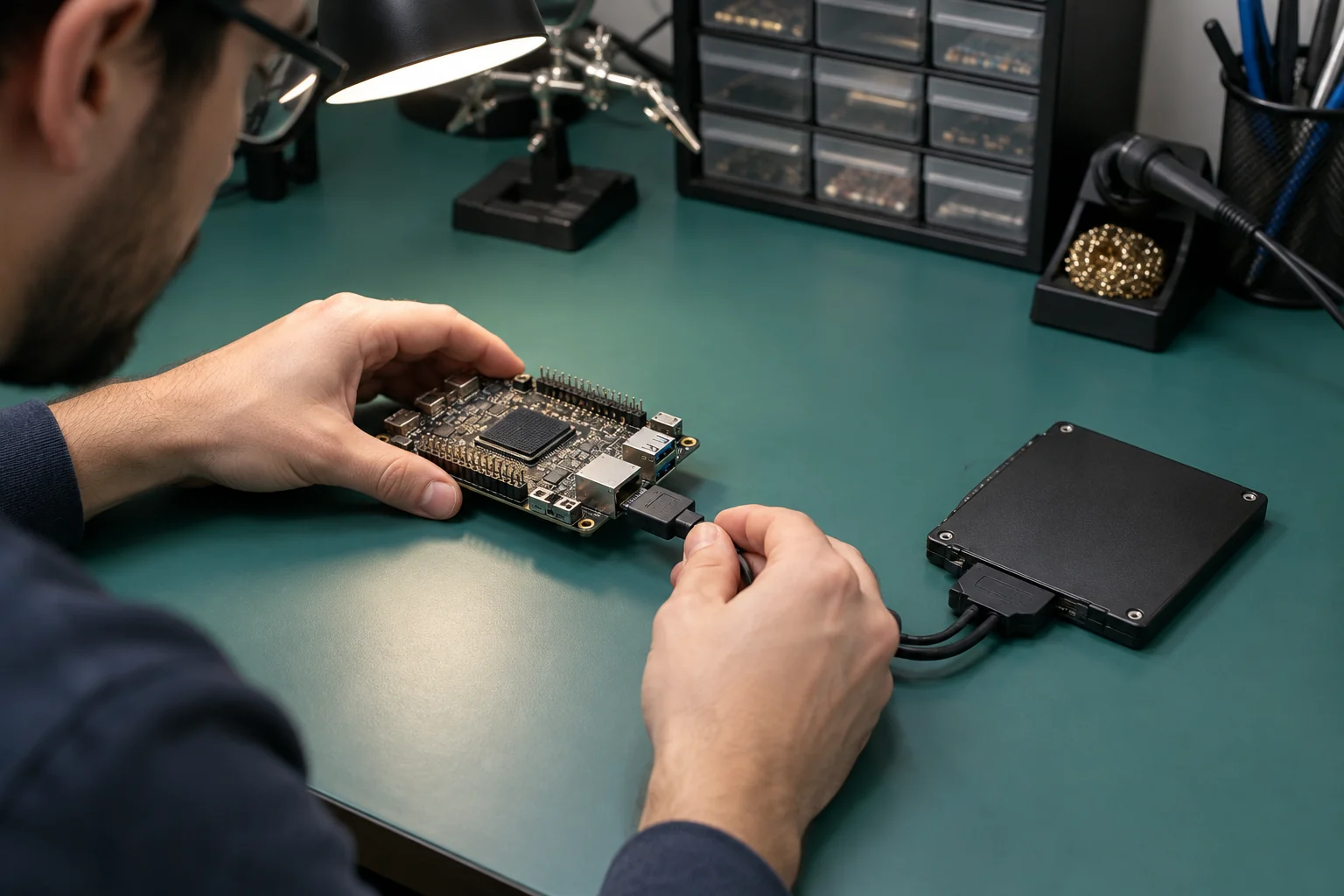
For an FPGA SATA host-IP decision, reliability is most useful when tied to a specific design boundary and evidence for the requirement being assessed. We recommend separating the meaning of a bus error from broader acceptance criteria, then recording the workload, configuration, and test scope that matter to the design.
The short answer
We recommend assessing FPGA SATA host-IP reliability against explicit requirements for the intended design, not a feature list or an error label alone.
Start with the boundary of the review: host IP, PHY, board, or storage system. Keep SSD endurance separate from other system concerns. For each requirement, record the evidence relevant to that boundary; if the candidate design has no supporting evidence, leave the requirement unresolved rather than extend a narrow result into a system-wide conclusion.
For a sustained-operation evaluation, describe the workload and stopping condition. Keep comparisons consistent by assessing each candidate against the same stated requirements and scope, while treating an ATA error label as a question to map to those requirements, not as a conclusion by itself. Our recommendation is limited to the evidence and boundary recorded.
What does reliability mean at the SATA host-IP boundary?
At the SATA host-IP boundary, reliability means defining the behavior under review: the Linux kernel documentation defines an ATA bus error as data corruption during transmission over the ATA bus.
That definition marks the scope, not a diagnosis of the wider system. The kernel’s ATA bus-error definition does not establish the error’s cause, frequency, or recovery behavior. Keep the boundary explicit.
In a design review, keep three questions distinct: does the review concern identifying an ATA bus error, specifying the response required by the design, or supporting a reliability claim about the complete storage system? These questions address different scopes, so an answer about transmission over the bus should not stand in for a conclusion about the whole system.
We recommend matching each claim to the layer its evidence covers. State separately what the evidence addresses about bus errors and what acceptance criteria apply to the complete storage system, then connect each claim to evidence for the relevant part of the design.
Which workload conditions should guide reliability evaluation?
Evaluate reliability against the workload the design must support: traffic shape, read/write mix, concurrency, operating duration, and the required system behavior after an interruption.
Make the profile specific to the design, not to a broad label such as “reliable.” Keep the traffic pattern, read/write mix, concurrency, and run duration distinct when the application includes steady traffic, bursts, or changing patterns. Include multiple streams only when they belong to the intended use case, and mark which conditions are essential to the decision. Keep the profile specific.
For an ATA error case that matters to the application, name the condition under review and the required system response. We recommend stating what outcome the system needs after that condition, just as you would for an interruption. This makes the requirement reviewable without treating “reliable” as a substitute for a defined behavior.
If another storage approach is part of the decision, compare it against the same workload description, operating duration, interruption outcome, and evidence standard. Otherwise, the comparison may change the conditions as well as the candidate. Because a result is meaningful only against the conditions it represents, keep the profile attached to each candidate and do not treat a result for one pattern as evidence for another without an explicit reason.
We recommend treating the profile as the boundary of the comparison, not as a reliability verdict. It defines what the evaluation covers; the evidence still needs to match those conditions. State the expected run duration and the required response after an interruption, then identify the evidence that supports each requirement. Separate required behavior from optional scenarios so reviewers can see what the decision depends on.
Keep every requirement in scope. A useful comparison pairs the same workload and evidence standard across candidates, with each result tied to its stated profile.
Where should compatibility checks sit across the IP, PHY and board?
Keep compatibility decisions separate across the IP, PHY, and board boundaries, then relate them to the target design. We recommend recording what the review covers at each boundary instead of allowing one answer to imply the others.
Questions to resolve at each compatibility boundary
| Boundary | Review question | Record |
|---|---|---|
| IP | Which IP configuration is in scope? | The selected configuration and open items. |
| PHY | Which PHY assumptions does the review include? | What is accepted, excluded, or unresolved. |
| Board | Which board variant and conditions are in scope? | The board scope and any exclusions. |
Use the same target design as the reference point, while letting each review item answer its own question. For Logic Design Solutions’ SATA Host IP, we recommend defining the compatibility question for the selected FPGA target and leaving an unreviewed pairing unresolved rather than extending a claim by analogy.
Do SATA connector types change the host-IP decision?
No, not by itself. We treat SATA connector type as a board constraint, not as a standalone basis for choosing FPGA SATA host IP. Keep connector fit and host-IP fit as separate review items.
Logic Design Solutions designs and licenses FPGA soft IP, including SATA Host IP. The practical split is simple: record the connector decision with the board assumptions, then compare the IP against the requirements for the design.
When the connector is fixed, record it with the board assumptions and keep the host-IP comparison tied to the requirements used for the design; if the connector remains open, keep that choice with the board and storage-device layout decision, then revisit the comparison only if those requirements change.
| Design situation | What to record | When to revisit the IP comparison |
|---|---|---|
| The connector is fixed | Its status as a board constraint, alongside the requirements used to compare the IP. | If a design requirement used in the comparison changes. |
| The connector is still open | The connector choice alongside the board and storage-device layout decision. | If that decision changes a requirement used in the comparison. |
If ATA error handling is part of the design, list it as a host-IP requirement rather than treating the connector choice as evidence that the requirement is covered. This keeps the review focused on what the design needs.
For Logic Design Solutions’ SATA Host IP, use the same distinction: reopen the comparison only when a requirement changes, not simply because the connector choice is fixed or still open.
How should a team validate reliability under sustained operation?
To validate reliability under sustained operation, define a continuous workload and stopping condition, then report SSD endurance separately from board, controller, and other system-level questions.
A published SSD endurance study continuously ran its workload and collected reliability data until the drives could no longer accept writes, over a period of months. That is evidence about the SSD under the test conditions, not a universal system reliability verdict.
The same study describes the JESD218 standard as covering SSD endurance and data-retention testing, but not circuit-board failures, controller failures, or radiation-induced soft errors, as explained in its discussion of the standard’s scope. Those exclusions define the boundary of an endurance result.
Logic Design Solutions designs and licenses FPGA storage IP. For a team assessing that kind of design, record the host-IP configuration alongside the FPGA image, board setup, and SSD. Record the workload and stopping condition too, and keep the setup description with the result. Keep the endpoint explicit.
For a bus-level error, report whether it triggered the stopping condition; otherwise, keep it distinct from the SSD’s write-acceptance endpoint. This makes clear whether the run treated the error as part of its reliability criteria or recorded SSD endurance as a separate result.
Compare an endurance run with a broader system-level review as separate evidence: the first follows the SSD under a defined workload and endpoint, while the second should address additional failure categories included in the design criteria. Use the report to distinguish what the run tested, what it excluded, and what remains untested, rather than combining those questions into one reliability claim.
We recommend reporting sustained-operation results with their workload, scope, and endpoint. Broader conclusions should rest on separately documented evidence for the additional concerns included in the system-level criteria, not on an endurance result alone.
When should a design use a different storage interface?
Use a different interface when the design requires NVMe host communication rather than a SATA host path. The NVM Express specifications define host communication with non-volatile memory across multiple transports and name 3 examples: PCIe, RDMA, and TCP.
We recommend making this decision from the interface and transport the system must support. SATA specified: keep its host path in scope. If the requirement specifies NVMe communication and names a transport, assess an NVMe-oriented option against that requirement. The protocol label sets the review scope; it does not, by itself, establish the reliability of a particular implementation.
| Requirement wording | Recommended design scope |
|---|---|
| The requirement specifies a SATA host path. | Keep SATA host IP in scope. |
| The requirement specifies NVMe host communication over a named transport. | Assess an NVMe-oriented option against that requirement. |
The interface choice answers which communication path to assess, while the design-specific criteria answer what evidence is needed to make the reliability decision, so keep the reliability evaluation tied to the selected implementation and its stated requirements.
What should the final reliability-based choice rest on?
We should base the final reliability choice on candidate-specific evidence mapped to acceptance criteria, while recording unresolved assumptions and system-level error handling. Feature coverage alone does not establish project fit.
Start with the project’s acceptance criteria. For each requirement, link the claim to evidence for the specific candidate and intended design, because a general feature description can support a capability statement without establishing that the project’s implementation meets its acceptance criteria.
For each ATA error case within scope, record what the design is expected to detect or report, the expected system response, and what evidence supports that response. Treat these as questions for the decision record, not as behavior implied by a feature list. If the response or its system-level implications are not established, mark them unresolved rather than assuming an answer.
When comparing candidates, use the same requirements and evidence standard for each. If the project is also considering another storage approach, compare it with SATA host IP only against criteria that apply to both. A broader feature list is not a substitute for a like-for-like comparison. The comparison is limited by the evidence available for the intended design; it can clarify what the record supports, but it cannot resolve assumptions that remain open.
- Requirements: State what the design needs from the SATA host IP.
- Evidence: Identify the documentation or project results supporting each requirement, and note whether they apply to the candidate and intended design.
- Error handling: Record the relevant ATA error cases, expected system responses, and supporting evidence.
- Open assumptions: Mark what remains unestablished and how it limits the decision.
- Ownership: Name who will resolve each open question before the choice is finalized.
Keep the evidence trail concise. Our recommendation is to make the final choice only as strong as the evidence tied to its acceptance criteria, and to carry unresolved questions into the decision rather than implying that broader feature coverage settles them.
Frequently asked questions
Are there different types of SATA connectors?
We treat connector choice as a board-level constraint, not a standalone basis for choosing FPGA SATA host IP; the discussion does not identify specific connector types. The design guidance addresses connector choice in relation to the board and host-IP decision.
Why is it called SATA?
SATA is named for Serial ATA because, unlike Parallel ATA, it transmits individual bits serially, as TechTarget explains; we use that distinction to explain the name.
Is SATA SSD slower?
Yes, compared with PCIe SSDs: TechTarget reports SATA SSD speeds of 600 MBps and says they are not nearly as fast as PCIe SSDs; we use PCIe as the comparison here.
In summary
Before finalizing the choice, record the evidence for each design requirement and whether it applies to the candidate and intended design. Keep unresolved assumptions visible and assign an owner to each open question. Separate the ATA bus-error definition from system acceptance criteria, and preserve the workload, IP configuration, board setup, SSD, and stopping condition with any sustained-operation result. If a requirement lacks evidence for the intended design, leave it unresolved rather than widening the reliability claim.
How we wrote this article
The sources we consulted are listed at the end of the article, consulted on 2 November 2026. Where we cite none, it is our opinion, and we write it as such.
This article gives buying criteria and our point of view. It does not replace a professional’s advice on a specific situation.
It is published by Logic Design Solutions, which therefore has an interest in the subject.
Sources
- Measurement and Analysis of SSD Reliability Data Based on Accelerated Endurance Test, mdpi.com
- libATA Developer’s Guide : The Linux Kernel documentation, kernel.org
- Specifications – NVM Express, nvmexpress.org
- Serial ATA (Serial Advanced Technology Attachment or SATA) | TechTarget, techtarget.com
- PCIe SSD (Peripheral Component Interconnect Express solid-state drive) | TechTarget, techtarget.com