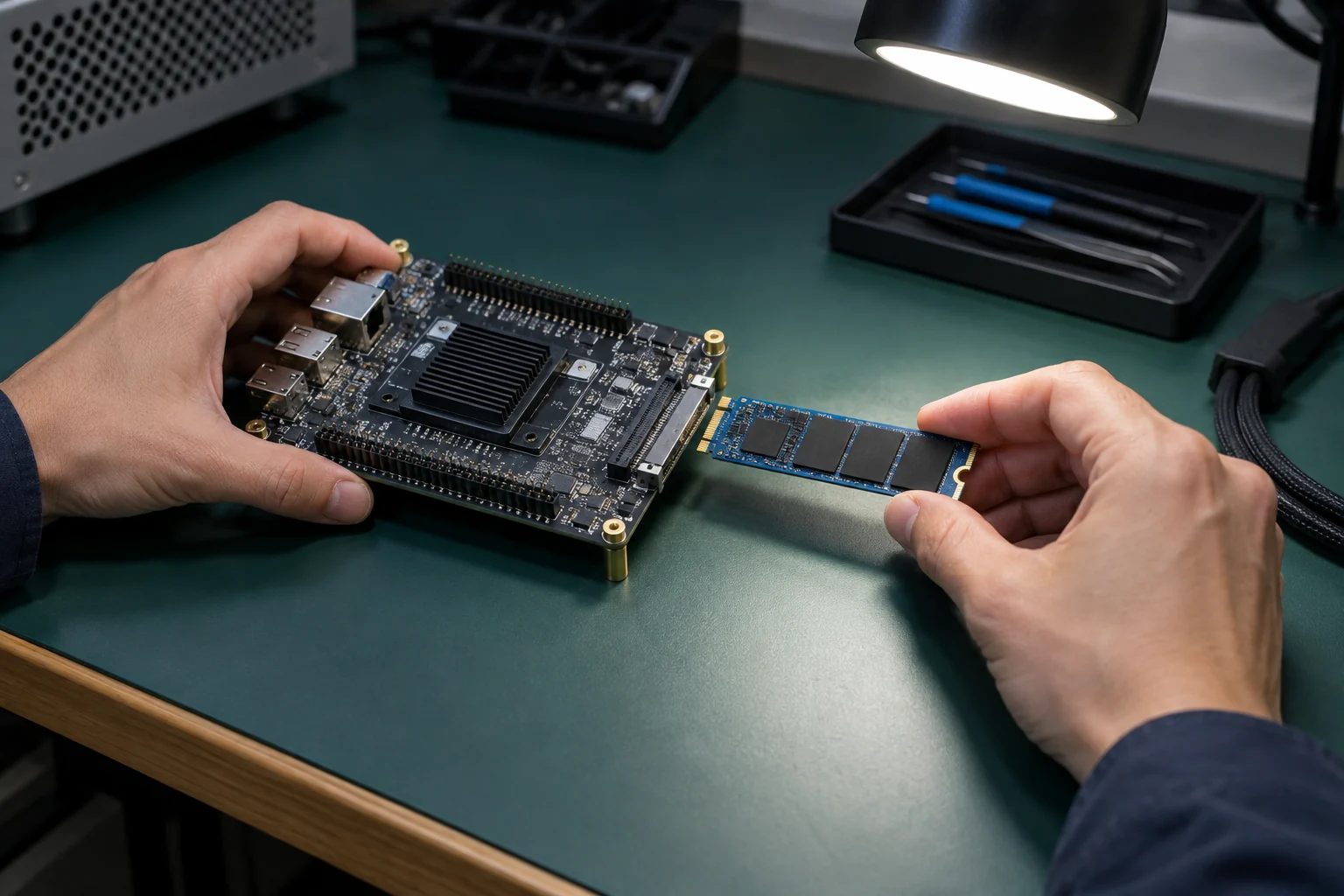
We recommend treating FPGA configuration trust and NVMe storage protection as separate design questions. Mark the host, PCIe link, and SSD boundaries before writing requirements, so “secure NVMe” does not hide who owns each control or what evidence a review needs.
The short answer
For secure NVMe data sharing on an FPGA, define configuration authentication and storage protection as separate requirements, then assign each to the relevant boundary: the FPGA configuration, host, PCIe link, SSD, or more than one of these. Specify whether authentication, authorization, encryption, isolation, and recovery are in scope without assuming a particular mechanism. Record an accountable owner and review evidence for every requirement. For device behaviors such as Sanitize, set pass/fail outcomes, including what the test checks after a reset. This turns “secure NVMe” into specific requirements a design review can assess.
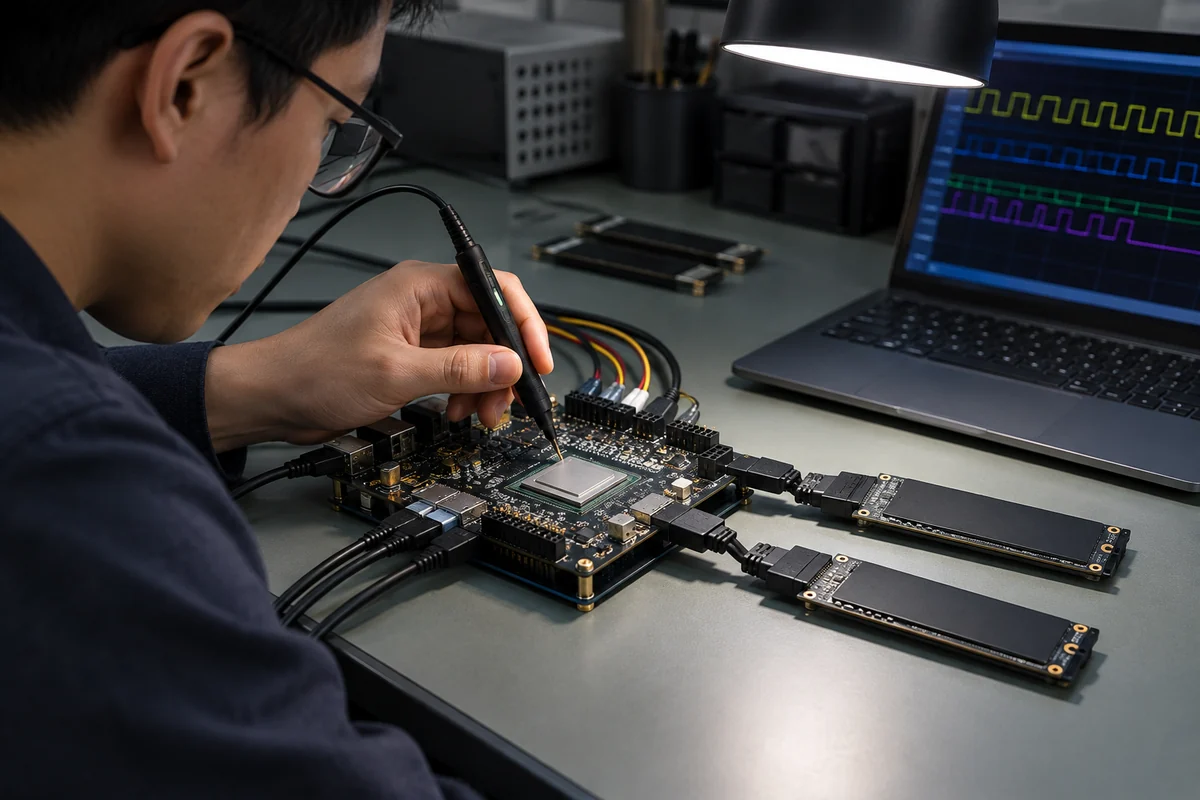
What does security mean for an FPGA-based NVMe design?
For an FPGA-based NVMe design, security means treating configuration authentication and storage protection as distinct requirements, while defining a secure response to authentication failure and selecting relevant storage controls, as covered by FPGA security guidance and storage security recommendations.
At the FPGA boundary, configuration-file authentication at power-up is essential, and secure recovery from an authentication failure matters just as much, according to the FPGA security guidance.
Make both items explicit in the design requirements. Keep the failure response at the requirement level until the implementation is chosen; specify the required security outcome without assuming a particular recovery mechanism.
At the storage boundary, NIST recommendations span security management and storage-specific concerns, including authentication and authorization, data protection, isolation, restoration assurance, and encryption, as described in its storage infrastructure security recommendations.
Keep these categories visible in the design brief. For each one, record whether it is in scope, what the design must satisfy, and what evidence a review will use to assess that requirement. This is a documentation recommendation, not a claim that one control or implementation fits every design.
The Trusted Computing Group also identifies drive-level self-encryption, access control, secure messaging, storage locking, and security subsystem classes such as Opal, Enterprise, Ruby, and Opalite as storage security topics. Treat these as topics to assess against the selected design, not as capabilities to assume without a requirement.
For secure NVMe data sharing, ask whether each requirement concerns the FPGA configuration file, storage, or both. Then make the intended scope clear: does the design need to address authentication, authorization, encryption, isolation, or recovery? Keep configuration trust separate from storage controls, so a broad label such as “secure NVMe” does not stand in for specific design requirements.
Where does the NVMe host fit in the storage architecture?
The NVMe host is the system-side endpoint that uses PCIe to access one or more SSDs; keep the host, the PCIe link, and each SSD distinct in the storage architecture, as described in the NVMe host and SSD architecture.
Start with three labeled blocks. Put the host on one side of the PCIe connection and the SSD on the other. Inside the SSD block, show its PCIe host interface, SSD controller, and non-volatile memory such as NAND, matching the NVMe description of SSD components. If an FPGA implements the host function, keep the SSD controller outside that host block. This separates the host function from the drive’s internal components without assuming that the protocol name describes one combined unit.
The host-side view also includes the driver’s use of NVMe memory-mapped controller registers and system DRAM for I/O submission and completion queues, according to the NVMe description of host registers and queues. Show those resources alongside the host and driver, rather than inside the SSD. For a design review, label the host-side registers and queue resources clearly so the discussion can distinguish them from the drive’s controller and memory.
Our recommendation is to use the diagram as an ownership map: assign each security question to a specific boundary, such as the host, the PCIe connection, or the SSD. Then record any requirement that spans more than one block. The architecture sources describe where the host, queues, and SSD components fit; the diagram should make those boundaries easy to discuss without implying a particular security mechanism.
That host-side distinction matters across several storage contexts. NVMe SSDs are popular in consumer electronics, data-center processing, and acceleration services; in the latter areas, specialized FPGA hardware plays a key role for application-specific workloads, according to SemiEngineering’s overview of NVMe SSD use and FPGA hardware. Keep the same host-to-SSD boundary visible when adapting the diagram to a specific workload.
Which security responsibilities should be assigned across the system?
We recommend assigning platform-firmware decisions to the relevant implementers, FPGA fielding tasks to the program, and procurement input to system administrators, security professionals, and users, with each handoff recorded in a responsibility matrix.
The NIST platform firmware guidance is intended for implementers, including OEMs and component or device suppliers, who can use it to build stronger security mechanisms into platforms.
Keep the boundary explicit.
For an FPGA-based NVMe design, use the matrix to make ownership specific rather than leaving “security” as a shared, unassigned task. Record the accountable organization, contributing suppliers, handoff point, and review owner for each responsibility. Keep platform ownership separate from FPGA fielding ownership, while making the connection between them visible in the handoff.
The FPGA security guidance says that, before fielding, the program will provision keys, set security bits, and load configuration files in NVM blocks. It also says the program should review the production-ready application and settings to ensure there are no unintended entry points or development features that could provide an adversary unauthorized access.
Turn those activities into explicit rows in the plan: identify who owns key provisioning, security-bit settings, configuration-file loading, and the production review. Give the review a named owner and a clear handoff; include the application and settings in its scope. This keeps the fielding work traceable to the program responsible for it without blurring supplier contributions.
Procurement belongs in the same allocation, not outside it. The NIST guidance on platform firmware says system administrators, security professionals, and users can use it to inform procurement strategies and priorities for future systems. Bring those roles into the allocation and state which requirements each implementer or supplier is expected to address. That gives the team a concrete basis for discussing ownership before selecting or integrating components.
How should engineers evaluate SSD performance on an FPGA?
Evaluate SSD performance on an FPGA by defining the intended workload first, then comparing results under matching test conditions.
Start with the task the design needs to support. Describe whether it involves sustained transfers, small requests, or a mix; specify the read and write patterns that matter; and decide whether the evaluation represents one requester or shared access. These choices give the comparison a concrete purpose rather than leaving it to a general score.
Keep the comparison tied to its purpose.
Choose evaluation criteria to match that task. Transfer rate may matter for one design goal, while response time or consistency across repeated runs may matter more for another. Set the priority before reviewing results, and state any acceptance criteria in terms of the system requirements rather than selecting them after seeing which result looks strongest.
When the design is intended to support shared access, include that use case in the evaluation plan, because a test that leaves out the intended request mix cannot answer the question the design team needs to resolve. Define the access patterns and number of concurrent users to include, then keep those conditions consistent when comparing candidates.
Record the SSD, FPGA design, software configuration, and test settings alongside each result. Keep the notes specific enough that the team can identify which conditions belong to each comparison. If a setting or configuration changes, label the result as a separate evaluation instead of placing it beside results gathered under different conditions.
For a practical review, put the workload, chosen criteria, and test configuration in one comparison record. That gives engineers a shared basis for discussing trade-offs and deciding whether a candidate fits the intended design, without treating one attractive score as a complete verdict. Compare like with like, and keep the use case visible beside every result.
What should an NVMe reference design let a team verify?
An NVMe reference design should let a team verify Sanitize outcomes, including metadata and queue clearing, and check what happens after a device reset.
Use Sanitize as a bounded verification target, not as shorthand for system-wide security. The NVMe Express FAQ’s description of Sanitize says it shares Format’s erase capabilities, removes metadata and information from queues, and automatically starts after a device reset to guarantee completion.
We would turn that description into explicit pass/fail questions. Does the test exercise Sanitize? Does it check the intended outcome for user data, metadata, and queue information? After a device reset, does the test confirm that Sanitize starts automatically and reaches completion? Keep each result tied to the behavior the test actually checks.
- Record whether the test covers erasure of user data, alongside the metadata and queue information named in the FAQ.
- Include a reset case and state whether Sanitize starts automatically afterward.
- Define completion as an acceptance outcome, rather than treating command initiation as sufficient evidence.
- Keep the test report specific about which outcomes it checked and which it did not.
The FAQ’s comparison with Format is a useful boundary for the test plan: it supports checking Sanitize’s stated erase capabilities, but it does not, by itself, describe every behavior a particular reference design should expose. Keep the claim narrow; do not infer extra reset behavior or additional guarantees from the comparison.
Our recommendation is to make the reset case part of the acceptance discussion, not a footnote. A test plan that names the expected restart and completion outcomes gives reviewers a concrete basis for assessing this behavior, while leaving broader security claims to their own tests. Report what the test verifies, not what the reference design is assumed to prove.
When should a design use SATA IP or custom FPGA development instead?
Use SATA IP when legacy SATA compatibility is required; assess custom FPGA development when neither protocol fits. For SSD applications prioritizing lower latency and scalability over legacy SATA compatibility, NVMe is the better fit, as the NVMe base specification states.
| Option | Decision trigger |
|---|---|
| NVMe IP | Choose it when the SSD application prioritizes lower latency and scalability over legacy SATA compatibility, as described in the NVMe base specification. |
| SATA IP | Keep it in scope when legacy SATA compatibility is a requirement. |
| Custom FPGA development | Assess it when neither protocol path fits the written requirements. |
Start with the interface requirement. Write down whether legacy SATA compatibility is mandatory, whether the SSD use case prioritizes the NVMe comparison criteria, and what requirement would remain uncovered by either choice. This separates a concrete compatibility need from a general preference for one protocol.
Keep security requirements explicit, but do not use the word “security” by itself as the reason to choose custom development. Translate the goal into a design requirement, then decide whether the protocol path under consideration fits that requirement. If the gap is unclear, clarify it before committing to a development route.
- State whether legacy SATA compatibility is mandatory.
- State whether lower latency and scalability take priority over that compatibility for the SSD application.
- Name the requirement that neither protocol path addresses before treating custom development as the choice.
Our recommendation is to make compatibility the deciding reason to retain SATA, then compare NVMe against the SSD requirements. Consider custom development only when the requirements point beyond those protocol choices, and define that gap before choosing the path.
What should procurement compare when selecting an FPGA NVMe host core?
Compare an FPGA NVMe host core by its supported command sets and transport bindings, its platform-security scope, and the compliance or interoperability evidence relevant to the intended specifications.
Separate command-set coverage from transport support. NVM Express defines I/O command-set specifications as extending the Base Specification, while transport specifications bind the NVMe protocol, including controller properties, to a specific transport. Keep those dimensions distinct in the procurement matrix, rather than treating “NVMe support” as one undivided item; see the NVM Express specifications.
Keep the scope explicit. For platform-level security, NIST describes mechanisms for protecting against unauthorized changes, detecting changes, and recovering from attacks. That creates a useful 3-part comparison lens, but it should not be read as a claim that an NVMe host core implements any particular mechanism. Use the NIST platform firmware resiliency guidance to frame the questions.
| Comparison area | What procurement should request | How to assess the response |
|---|---|---|
| Protocol scope | A list of supported I/O command sets and transport bindings. | Check each item against the specifications required for the design. |
| Platform security | A description of the core’s stated security scope and its boundary with platform-level measures. | Compare the response against protection, detection, and recovery, without assuming the core covers all three. |
| Compliance and interoperability | Testing information tied to the relevant NVMe specifications. | NVM Express and the University of New Hampshire InterOperability Laboratory conduct compliance and interoperability testing for NVMe, NVMe-oF, and NVMe-MI; see the NVMe compliance and interoperability testing information. |
| Integration assumptions | Documentation of the target configuration, interfaces, dependencies, and items left to the design team. | Compare the stated assumptions with the project’s own requirements. |
Our recommendation: make evidence tied to the exact specifications a procurement requirement, then record any unverified scope as an open item rather than treating a broad compatibility statement as proof. This keeps protocol coverage, platform-security responsibilities, and test evidence distinct during technical review.
In summary
Now make the design brief reviewable: draw the host, PCIe link, and SSD as separate blocks; list each security outcome, its owner, evidence, and acceptance test; and include reset and Sanitize behavior in the test scope where relevant. Before choosing an NVMe or SATA IP path, or scoping custom FPGA development, compare the written requirements with command-set coverage, transport bindings, security scope, and interoperability evidence.
How we wrote this article
The sources we consulted are listed at the end of the article, consulted on 3 November 2026. Where we cite none, it is our opinion, and we write it as such.
This article gives buying criteria and our point of view. It does not replace a professional’s advice on a specific situation.
It is published by Logic Design Solutions, which therefore has an interest in the subject.
Sources
- Evaluating NVMe SSD Multi-Gigabit Performance, semiengineering.com
- CTR_FPGA_SECURITY_GUIDANCE.PDF, media.defense.gov
- SP 800-209, Security Guidelines for Storage Infrastructure | CSRC, csrc.nist.gov
- Storage Security | Trusted Computing Group, trustedcomputinggroup.org
- Base NVM Express : Part One – NVM Express, nvmexpress.org
- Platform Firmware Resiliency Guidelines | NIST, nist.gov
- Specifications – NVM Express, nvmexpress.org
- Testing & Compliance – NVM Express, nvmexpress.org
- How do you securely erase data on an NVMe SSD? – NVM Express, nvmexpress.org
- NVM Express® Base Specification – NVM Express, nvmexpress.org