
A cross-vendor FPGA design may be technically portable while its IP license still limits which device families or uses are covered. Before comparing FPGA IP licensing models, define the boundary your project needs: target families, permitted activities, deployment scope, and reuse.
The short answer
Choose an FPGA IP license by matching its permitted uses to the design you plan to ship. Compare licensing with building the controller in-house, and keep technical portability separate from contractual permission.
Start with scope. Technical portability concerns the FPGA vendors and device families a core targets, while license scope covers the uses the agreement permits; because they answer different questions, list the target vendors and device families, then note whether evaluation, prototyping, production, modification, and redistribution are included.
Map the grant to the planned use: one design, product variants, or reuse across projects. Specify who may use the IP and what the license applies to. For an NVMe Host core, record the target FPGA, required features, specification revision, integration boundary, and delivery needs, then compare these requirements with the license scope rather than assuming device compatibility grants permission.
Use the same design requirements to compare licensing with an in-house implementation. Include the intended deployment and the license terms in that comparison. Our recommendation: choose the license only when its stated grant matches the planned use. A portability label alone does not establish that the contract permits that use.
What does a licence need to cover across FPGA vendors?
A license should name every covered FPGA vendor and device family, then define permitted uses, modification rights, redistribution terms, and the scope of permission. Keep technical portability separate from contractual rights.
This guidance comes from Logic Design Solutions, which designs and licenses soft-IP cores for FPGA storage and data-bus control. That vendor affiliation informs our perspective: the review should define license scope, not treat portability as a grant of rights.
The IEEE 1685-2022 description of portability explains that tool-independent access to methodology-independent metadata supports portability of design data, methodologies, and environment implementations. That describes portability, not license rights.
Keep the concepts separate in the review. Portability concerns whether design data and methods can work across tool environments; the license scope concerns what the recipient is permitted to do with the IP.
For each intended target, name the vendor and FPGA family covered. If your design spans AMD (Xilinx), Altera, or Microchip devices, list the specific families instead of relying on “multi-vendor support.” That phrase alone does not define the license scope.
List evaluation, prototyping, production, modification, and redistribution separately as permitted uses. Do not infer permission for one activity from wording about another; define each activity within the scope being licensed. State whether the license applies to the named IP, the target devices, the project, or a combination, and record any limits on who may use the licensed material and where.
When a design spans vendors, put each vendor and family on its own line, then map permitted uses, modification rights, redistribution, and license scope against the project, so engineering and procurement can assess the proposed terms against the same implementation.
For a license-versus-in-house comparison, use the same project requirements: target families, intended uses, modifications, and redistribution. Our recommendation: use a vendor-by-vendor scope table in the review, with device families and permitted uses on separate lines. That keeps the discussion focused on the rights the implementation needs, rather than treating portability as a substitute for contractual permission.
How should deployment scope shape the licensing comparison?
Let the deployment boundary, not the license label, set the comparison: distinguish a single design, planned product variants, and reuse across projects, then compare each offer against the scope you need.
Start with one design. The key is to compare like with like: a license considered for one design should not stand in for the separate question of coverage for variants or reuse across projects.
| Deployment scope | Question to compare |
|---|---|
| One design | Does the offer cover the design and intended use in your brief? |
| A product with planned variants | Are those variants within the scope you need, or should each be considered separately? |
| Reuse across projects | Does the offer address reuse across the projects you have in mind, or only the initial design? |
A single-design license and a license considered for variants or reuse are not interchangeable comparison units, so define the intended boundary before comparing what each offer covers. Keep the current deployment distinct from future possibilities; otherwise, the comparison can blur what the design needs now with broader scope you may later consider.
For an NVMe Host IP such as Logic Design Solutions’ offering, make the comparison concrete: name the FPGA target, the design, the variants you expect to support, and any reuse you are considering. Logic Design Solutions is named here because its NVMe Host IP is the example; apply the same scope questions to that offer as to the other options you compare.
Our recommendation is to compare each offer against the current deployment first, then assess broader scope against a defined variant or reuse case. This keeps the decision tied to an engineering need rather than to a license label that may not describe the boundary you require.
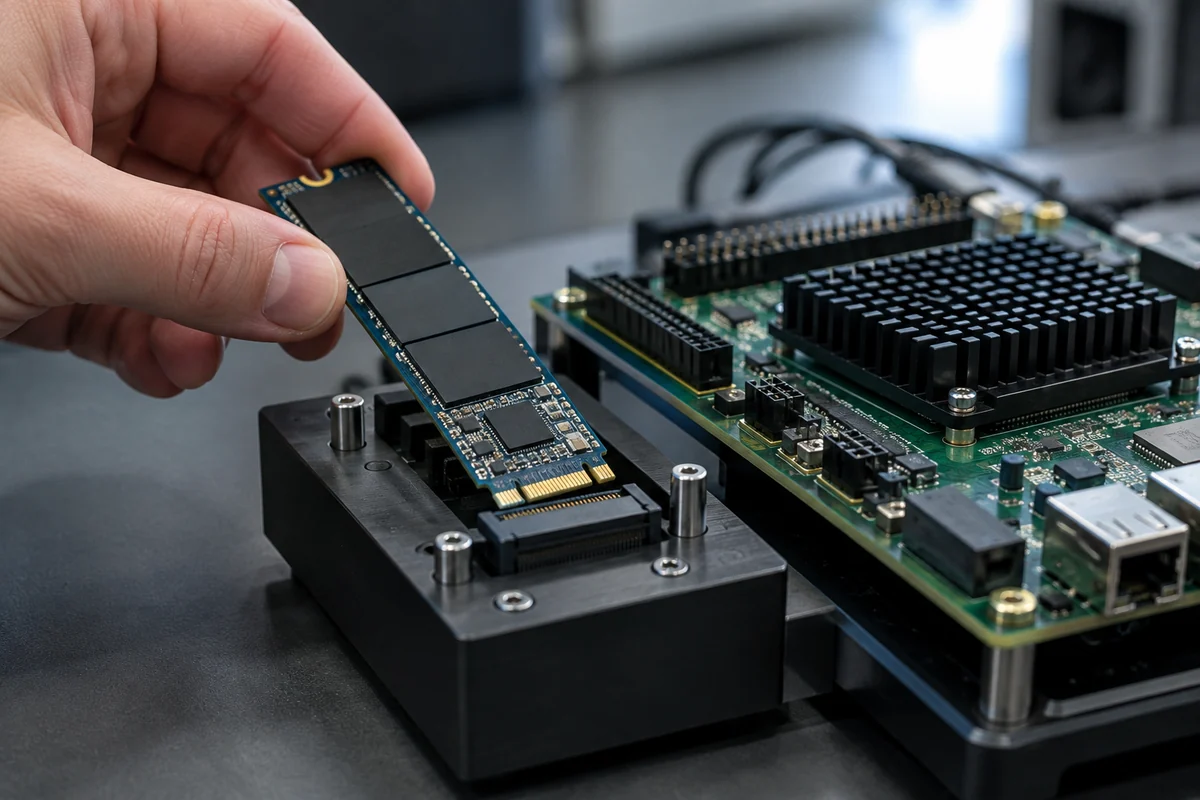
How does an enterprise SSD deployment affect NVMe host IP selection?
An enterprise SSD deployment affects NVMe host IP selection through its application environment, required features, and specification revision, not the “enterprise” label alone. SNIA’s use-case guidance says requirements and environments differ by use case.
Start with the workload. Our recommendation is to record the application environment first, then list the NVMe capabilities and specification revision the design requires. Keep those entries separate: one describes the use case; the others define the technical selection criteria.
| Selection input | Action for the design team |
|---|---|
| Deployment use case | Describe the application environment before shortlisting a core, following SNIA’s use-case guidance. |
| NVMe features and revision | Record the required features and specification revision. The NVM Express specification page identifies updates for Zoned Namespaces (ZNS), Key Value (KV), Rotational Media, and Endurance Group Management. |
Keep the use case separate from the feature list. The use case frames the application environment; the feature list and revision make the technical selection criteria explicit. Treat the feature names on the NVM Express specification page as prompts for project requirements, not as a default checklist, because a listed capability does not establish that a particular deployment needs it.
At the comparison stage, match each required feature and revision to the available material for the candidate core and its license. Leave any unaddressed item unresolved rather than assuming support from the product category. That keeps the selection record tied to what the design actually requires.
Do not treat “enterprise” as a feature requirement. Make the selection record specific enough to distinguish the intended application environment, required NVMe capabilities, and target specification revision. For context, Logic Design Solutions licenses soft-IP cores, including NVMe Host IP.
How should engineering effort affect reuse versus replacement?
Our recommendation: compare licensed-IP reuse with replacement against the same requirement, including license fit and integration work. Choose the path with the clearer work estimate, and keep unresolved assumptions visible.
Logic Design Solutions designs and licenses soft-IP cores and offers custom FPGA design services. We write from that engineering and commercial context, so the comparison should turn on scoped work, not an assumption that reuse is automatically faster.
According to a paper on design reuse published by JComputers.us, reuse is often practiced to reduce development time and effort, which makes it a reason to evaluate reuse, not a promise that it will take less effort for this design. Apply one functional requirement to both estimates, and separate defined tasks from unresolved assumptions.
Keep estimates separate.
| Path | Work to include in the estimate |
|---|---|
| Reuse licensed IP | License fit, adaptation, integration, and planned wrapper work. |
| Build a replacement | Design and validation work for the required block. |
For reuse, spell out what needs adapting and integrating; for replacement, define the design and validation work included. Compare like-for-like scope, rather than an idealized reuse path against a fully scoped replacement.
In a FPGArelated discussion of a third-party IP option, the author writes, “I can’t find a 3rd party with a comparable commercial IP offering, so “plan B” is rolling my own (four weeks labor?).” The question mark matters: four weeks is a tentative estimate, not a benchmark. Treat it as one engineer’s question about effort, not a planning duration for another design.
The same FPGArelated post about partitioning and a CPLD alternative considers quarantining code in its own partition and distributing only the necessary wrapper. It also considers putting a low-volume product in its own CPLD, which the author describes as excessive. These are options raised in that discussion, not effort estimates for your design.
Do not treat a partition or wrapper as proof of permission; use the license wording to determine whether that reuse path fits. Keep license fit distinct from implementation effort so the two questions do not disappear inside one total. If the reuse estimate depends on a wrapper or partition, list that work separately; for a replacement, state which design and validation tasks the estimate covers.
What does GPL-licensed RTL mean for a commercial FPGA project?
A commercial sale of copies of a modified GPL-covered program is permitted only under the GPL’s terms, according to the GNU GPL FAQ’s explanation of commercial sales.
This section is published for Logic Design Solutions, which designs and licenses soft-IP cores for FPGA projects. That affiliation is relevant context for a discussion of licensing.
For an FPGA storage design, start with the transaction, not the broad project label: record the planned commercial activity and the RTL files under review, then assess the sale condition and file changes as separate questions. The FAQ addresses the specific case of selling copies of a modified GPL-covered program, so keep that boundary in view rather than treating “commercial FPGA project” as a complete description of the activity.
Our recommendation is to make the intended license basis an explicit decision point. If the planned route is the stated commercial sale, assess whether the project can proceed under the GPL’s terms. Do not infer the terms of an alternative route from the FAQ’s statement about that sale.
Modified files need their own review. The GPLv2 license text on notices for modified files requires prominent notices identifying changes and their dates. Add a file-level record of the relevant change notice and date. The notice must identify both the changes and their dates.
A concise decision record can keep the review focused:
- State whether the planned activity is a commercial sale of copies of a modified GPL-covered program.
- Record whether the project accepts the GPL terms for that scenario.
- Identify the RTL files planned for modification.
- For modified files, account for the prominent change notices and dates required by the GPLv2 license text.
Keep the checks distinct: one concerns the terms for the stated commercial sale, while the other concerns notices on modified files. Do not use one general “commercial use” label to stand in for both. This gives the engineering and licensing review a concrete scope without extending either source beyond what it addresses.
Sources
Which technical and licensing questions should procurement resolve before selection?
Procurement should confirm that the license covers the intended PCIe host implementation. NVMe uses PCIe to transfer data to and from SSDs, according to the NVMe over PCIe transport specification. We recommend settling that boundary first.
Start by asking which functions are included in the licensed host implementation, which interfaces are covered, and where the surrounding FPGA design begins. Keep the discussion tied to the intended architecture rather than treating “NVMe IP” as a complete technical definition. Record assumptions about handoffs, configuration responsibilities, and dependencies in the procurement requirements. If the engineering and procurement teams use different definitions of the boundary, they may assess different technical and contractual scopes.
Next, separate technical coverage from usage rights. Ask whether the license permits the intended integration, modification of the implementation, use in the planned product, and maintenance by the teams that will own it. If affiliates, contractors, or later product variants matter to the project, ask how the grant treats each case. Do not infer permission from technical compatibility: request the grant, exclusions, and conditions in language procurement can map to the project. Keep the answers testable.
Define what a complete delivery means for the purchase. List the design files, interface information, documentation, verification materials, and support commitments the project requires, then ask the supplier to identify which items are included, optional, or outside the license. Attach acceptance conditions to each required item, so engineering and procurement can assess the agreed package against the same requirements.
Finally, record the licensed configuration, permitted and excluded uses, delivery items, and any update or maintenance terms. Specify how the teams will handle a mismatch between the agreed configuration and the delivered IP. Avoid a generic “NVMe license” entry in the purchase record: it leaves the technical boundary and granted rights unclear. A concise schedule tied to the requirements gives both teams a shared basis for the decision.
When should a team choose a commercial NVMe host core or custom development instead?
Choose a commercial NVMe host core when it covers the required behavior and firmware reuse matters; choose custom development when a defined requirement falls outside the core’s scope.
Logic Design Solutions licenses soft-IP cores and offers custom FPGA design services. We have a commercial interest in both paths, so our decision rule is requirement fit, not a blanket preference for either one.
| Path | Choose it when | Decision limit |
|---|---|---|
| Commercial NVMe host core | The core meets the behavior the design requires, and reuse matters to the decision. | Potential reuse benefits do not guarantee a particular project outcome. |
| Custom development | A specific requirement cannot be met by the core under consideration. | “Custom” is not, by itself, a reason to choose this path. |
Start with the design, not the label. “Required behavior” means what the FPGA-based design needs its NVMe host to do; the decision is whether the candidate core covers those needs or leaves a specific gap. A general preference for customization does not name that gap.
Reuse can be valuable, but it is not a project result to assume. The SEI guidance on designing for reuse of configurable logic says: “Reuse of FPGA firmware components can further reduce the system development cost and time-to-market, while also providing product quality improvements.” We treat those as potential benefits, not guaranteed results for a specific design.
That is the hinge.
For each required behavior, record whether the commercial core meets it, does not meet it, or leaves it unconfirmed. Keep “unconfirmed” distinct from “unsupported”: an unknown is not proof that the core fails the requirement. Then identify any unmet requirement that would make custom development necessary. This keeps the decision tied to the design’s needs, rather than to the label attached to either path.
Our recommendation is to choose only after that fit assessment. Compare the core’s stated scope with the design’s requirements, while keeping in mind that this comparison does not establish which path will have lower cost, a shorter schedule, or higher product quality. If neither option fits the requirements as written, keep the decision open and revisit the design boundary before committing.
In summary
We recommend turning the intended design into a scope record: name the FPGA vendor and family, deployment, permitted uses, modification and redistribution needs, and required NVMe features and specification revision. Mark unclear integration, delivery, or reuse terms rather than treating them as included. Then compare each offer against that same record and carry unresolved license wording into procurement before selection.
How we wrote this article
The sources we consulted are listed at the end of the article, consulted on 3 November 2026. Where we cite none, it is our opinion, and we write it as such.
This article gives buying criteria and our point of view. It does not replace a professional’s advice on a specific situation.
It is published by Logic Design Solutions, which therefore has an interest in the subject.
Sources
- comp.arch.fpga | practical experience with GPL IP core in commercial product, fpgarelated.com
- NVMe SSD Classification | SNIA | Experts on Data, snia.org
- NVM Express® Base Specification – NVM Express, nvmexpress.org
- Verification Components Reuse – Volume 7 Number 11 (Nov. 2012) – JCOMPUTERS, jcomputers.us
- Frequently Asked Questions about the GNU Licenses – GNU Project – Free Software Foundation, gnu.org
- GNU General Public License version 2 : Open Source Initiative, opensource.org
- NVMe over PCIe Transport Specification – NVM Express, nvmexpress.org
- Designing for Reuse of Configurable Logic | CMU Software Engineering Institute, sei.cmu.edu
- IEEE SA – IEEE 1685-2022, standards.ieee.org